A Note on Language

We at PerchedCrowPress have two writers on our books who write novels based in Ancient Ireland. Micheál Cladáin and John De Búrca have both faced criticism for using anachronistic language. In Micheál’s case, it has always been a generic “the language can be too modern”. However, for John, actual turns of phrase have been highlighted, one such being:

“The phrase ‘energy levels’ seems so alien to the rest of it. According to etymonline.com both words started to be used in this way in the 1600s.”

The review is 1837 words, and the critic spent 624 discussing the issue, using turns of phrase like “…utterly out of place…” so obviously felt very strongly about it.

Our editor has several issues with these types of criticism:

  • the books are set in Ancient Ireland
  • before the 1600s 
  • and our readers are modern.

Ancient Ireland

“…‘energy levels’ that feels out of place for a group of warriors and village boys in dark age Ireland.”

The language in “Dark Age Ireland” (up until about 700 CE) was Gaeilge Ársa (pronounced gwailga orsa). Following the critic’s logic, this means that to be authentic, the dialogue of John’s novels should be in that language. Even modern Irish speakers would have difficulty understanding the books if that were the case, and DNF piles would be growing globally. 

What about written language? Aside from Latin, there was no written language in Ancient Ireland; history and stories were verbal, passed from druid to druid and filí to filí (bard to bard). The Last Five Swords should be spoken in a pub by a scéalaí (shkaylee) standing in front of a firepit. Picture Pippin talking about his friend Frodo in The Prancing Pony, with lots of mug-toting punters listening in rapture. 

Knowing John well, he would make an excellent scéalaí and has striven for that atmosphere in The Last Five Swords (successfully, in my humble opinion).

before the 1600s

“The phrase ‘energy levels’ seems so alien to the rest of it. According to etymonline.com both words started to be used in this way in the 1600s.”

Let’s imagine that Gaeilge Ársa did not exist, and the common language of the time was English. Modern English originated in the late 14th century but did not reach fruition until the time of Shakespeare (about 1550). Before 1600 the standard language would have been Early Modern English, which most English readers today would struggle with. However, the critic wrote that the language is anachronistic because The Last Five Swords is set a thousand years before 1600. In 600 CE, even Old English didn’t exist. Spoken language was a mix of the various immigrants to “Dark Age Britain”, such as Latin, Gaelic, and Saxon. In Ireland, it was still Gaeilge Ársa (more info HERE). 

How far back does the language of historical novels have to stretch? So far that…

our readers

…will not understand it, it seems.

If it needs to be before 1600 — as the critic implies — that would undoubtedly be the case.

But what about our readers? What are they looking for?

“…using out of place language grinds up against the suspension of disbelief.”

Most modern readers would not understand what the critic even means by that statement because they would not have attended “Creative Writing 101”. But let’s humour them; let’s say it’s true, there needs to be suspension of disbelief: the story needs to be authentically set. Is that credulity going to be battered by using words the reader understands, like energy and levels?

John has spent a great deal of effort in world-building in The Last Five Swords: from quotations in Gaeilge to a glossary and reference to ancient traditions and charcoal sketches to set the scene. We see magic swords and Fae princesses, evil Fae ambassadors and monsters, and mercenary warriors wearing boiled leather armour. If the disbelief of our readers is not suspended by John’s efforts, our editor has promised to eat a boiled leather cuirass instead of beef for his Sunday lunch.

Language and Pronunciation

We are often asked for some guidance on the language and pronunciation of our novels set in Ireland.

The language of pre-Christian Ireland was a proto-Celtic Indo-European language. Meaning there was a single origin for the Celtic languages, which later developed into regional versions and originated in Europe. Celtic arrival in Ireland brought Ancient Irish with it. Scholars think the arrival, whether by migration or invasion, might be as early as 500 BCE. Languages did exist before Ancient Irish arrived. However, by the time of Christ, Irish was the common language. Ancient Irish is known as Gaeilge Ársa (pronounced gwailga orsa) or Primitive Irish (a Goidelic language), which survives only as ogham inscriptions. As such, historians have little understanding of how the words sounded.

That said, pronunciation in the different Kingdoms was likely to be different. This is, of course, still true of the country today. A Cork man speaks with an entirely different lilt to say a Dubliner or someone from Ulster. This further complicates what is already a complex topic. 

It is a reasonable assumption that Ancient Irish evolved into Old Irish, carrying some pronunciation with it.

Medieval monks used Old Irish (Sengoídelc) when they transcribed Irish Mythology. Sengoídelc was spoken in Ireland from about 700 to 1000 in the common era (formerly anno domini). As such, the examples adhere to Sengoídelc.

The pronunciation rules for Old Irish could fill a book. Rather than provide them, the following lists some names and places in After Gáirech and The Last Five Swords. When reading the examples, keep the following in mind:

Not necessary – How the words were pronounced over two thousand years ago will not impact the story. No one will ever know. You can pronounce them however you like.

Consonants – The pronunciation of consonants depends on their position in a word. For example, m at the beginning of a word is as in English. However, in other positions, it can take a v or w sound, such as Temuir (Tara) is pronounced Tay-vir

Vowels – The pronunciation of vowels and their position are changed when they are accented. For example, as the first syllable in a word is long (farther), and as the second syllable is short (pass). When the á is accented, it is long (ah as in car) but does change when positioned with another vowel: áe – gives an eye sound, as in bye; ái – gives an a sound as in hand;  – gives an e sound as in seed.

This is also true of other accented vowels: ó – gives an oh sound as in show; óe gives an a sound as in hay; ú – gives an oo sound, as in brood; é – gives an a sound as in hay; í – gives an ee sound, as in seed.

There are many more rules, and I won’t list them all here.

With those in mind, here are some of the names from After Gáirech, with their phonetic spelling:

Bóand – The River Boyne. Pronounced bow an.

Cailleach – Ancient crone (witch). Pronounced Kay lee ack.

Clochbeag – A village in the west. Pronounced Clochbeug (clearing the throat as for ch) 

Crúachain – The royal seat of Connacht. Pronounced cruck an.

Draíocht – Magic. Pronounced dree-ocht.

Dún – a fortress. Pronounced doon.

Emain Macha – The royal seat of Ulster. Pronounced eh-vin macca.

Gáirech – The battle that happened at the end of the Cattle Raid of Cooley. Pronounced gareck.

Léine – A soft linen shirt. Pronounced lay na.

Medb  The warrior queen of Connacht. Medb is pronounced as it would be for the Anglicised spelling Maeve, may ve.

Morrigan – The Goddess of war and fate. Pronounced mor ee gan.

Ráth – A circular earthen fort, as in a ramparted fort. Pronounced raar.

Scéalaí – A storyteller. Pronounced shkaylee.

Scáthach – The warrior witch from the Isle of Skye. Pronounced Scar thack.

Uisneach – A town in the Midlands. Pronounced ush-neeock. 

Author Page – John

John lives on the mysterious and rugged shores of the West of Ireland in Galway. From a young age, John was immersed in the rich traditions of Irish oral language storytelling, amassing a vast collection of mythology and folklore. He joined a storytelling group when he could find one and started to hone his skills.

John’s debut novel, The Last Five Swords, is an epic fantasy adventure set in a dark and beautiful ancient Ireland. It will be published by PerchedCrowPress in the Autumn.

John’s Books:

When Eoghan and Rúadhan find a girl up a tree, it heralds an epic journey.
Rhíona is a Fae princess on a quest to find a hero. She is hunted by her father and his agents, ambassadors and assassins, all set on thwarting her plan.
They soon fall in with Donnacha, an archer with a secret.
Together, the four enlist the help of the last of the fénnid. A world-weary group, far removed from the legends described in fireside stories.
In the dying days of magic in Ireland, the motley band sets out to find the greatest champion ever known: a man long thought dead. There is no other choice because only Fionn Mac Cumhal can save Ireland one last time.
“Wonderful Irish fantasy storytelling by debut author, John de Burca” — Conor Kostick, international bestselling author of Epic.

Buy the book
Eimear was born to the sound of violence.

Her parents broke the ancient geis and fell in love, despite coming from different races. Murdered on the day Eimear is born, a knowing infant, their legacy is one of pain and loneliness.

Although watched over by the duillecháns, Eimear’s childhood is unforgiving. She moves from one evil guardian to the next, that is, until she finds Sword and discovers its music. Sword’s discovery starts her on an epic adventure across multiple worlds–a journey of self-discovery and an introduction to further horrors.
Eimear’s journey brings her into the world of the Fae, where a bottomless crease divides the worlds of the Fane and the Fand–the King and Queen. The King and Queen want to use Eimear to unite their world and begin a reign of conquest and subjugation where no world is safe. Unaware that they are being manipulated, they march on blindly towards their destruction.

Buy the book

Menai Straits

Writing the battle of Menai Straits.

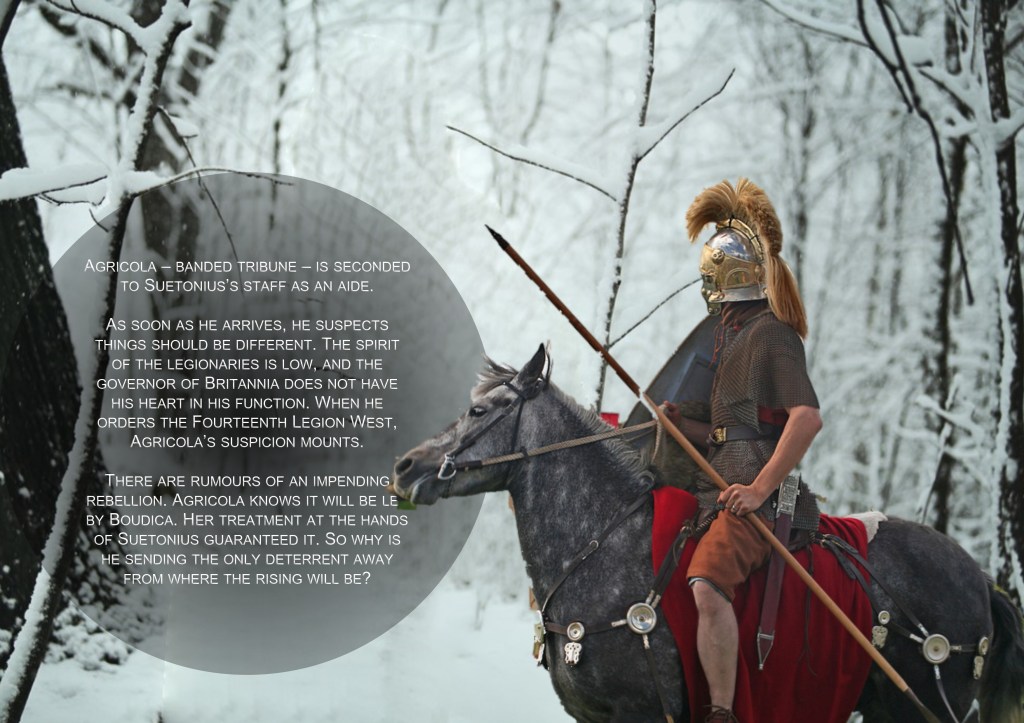
Druidesses cause the XIV Legion to halt their crossing through fear. Agricola will lift them to a resounding victory.

Warriors beside the Menai straits

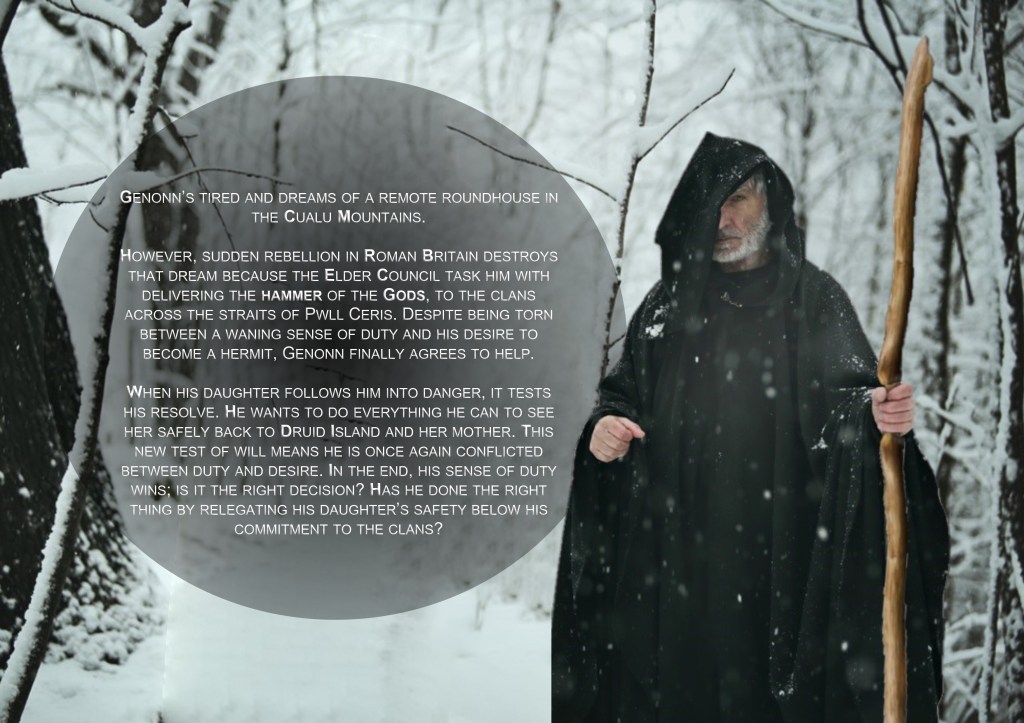
Hammer: coming in the Autumn.