For Christmas, all three book set for £4.99.
Son of Light, Daughter of War, and after Gairech.
Intrigue, battle, betrayal and love — what better fare to join your mince pies.
Get the books here!
Publishing Services
For Christmas, all three book set for £4.99.
Son of Light, Daughter of War, and after Gairech.
Intrigue, battle, betrayal and love — what better fare to join your mince pies.
Get the books here!
An unlikely team thrown together to battle against a hidden enemy. Love, crime, blood, and intrigue in Southern Italy. Good food, sea, sun, and Mafia.


The thrill of the sea spray, the wind, the bouncing and jostling of the Zodiac always excited him. He could think of nothing he would prefer at three in the morning. Stefano had the compass and kept waving directions when he veered, pushed off course by an unforgiving sea.
The chop got worse as Capri receded. There was no protection from the wind, but he loved it. He was captain, so he had the wheel. And what a wheel. What speed. He had no idea what knots were but knew he would be doing over thirty klicks an hour with an open throttle. On the sea, that was a fantastic feeling.
Stefano started to wave. Beni eased back on the throttle. He, too, could see the beam of light lancing from a point at sea where no land could be. The freighter. As soon as they were gently rocking in the waves, he lifted his torch and flashed a response. It was a game. Buttagazzo had told him the Guardia could do nothing. They were outside Italian waters. The threat would be when they were returning.
Beni didn’t think there was much threat, even when they were returning. This was his fourth trip, and he’d seen nothing of the sbirri or the Guardia. It was as if they didn’t care. They had billions of lire’s worth of hi-tech boating resting idly in the port of Miseno. Sure, he’d heard the engines booming across the bay. Anyone who lived around Baia had listened to those engines. They shook buildings and made teeth rattle. Beni had never seen one.
The freighter had a loading door in the hull. After they pulled up alongside, it didn’t take long to load the crates. Ten minutes and he was again feeling the thrill of pure power. The bow lifting out of the waves like some monstrous creature from the deep, one of the spooky black and white ones from the American films he’d snuck in to see.
They’d made it into the gap between Capri and the coast when Stefano started to wave frantically like he was signalling an aeroplane with a paddle. Beni eased off the throttle and let the Zodiac come to a rest, swaying gently in the wash.
‘What’s up?’
‘Can’t you hear it?’ Stefano frowned at him.
Cupping his ear, Beni listened. Finally, he could hear a muted roar over the other noises. It was growing. ‘What’s that?’
‘That’s the Guardia interceptor. They’re coming for us.’
‘What are we going to do?’ Beni asked.
‘We’ll have to run for it. Hope they miss us.’
‘Are they likely to?’
‘No idea. Only one way to find out,’ Stefano said, his glum look a sure indication of what he thought their chances might be.
They found out quickly.
As they raced out from their cover, the interceptor was frowning at them with a glaring white light. Splashes of water in front of the Zodiac were followed by a booming dub, dub, dub, and a mechanical voice ordering them to heave to. There was no arguing with the guns, which would tear the Zodiac into plastic strips and its crew into shark food. Beni turned the engine off and waited calmly.
He knew he had nothing to fear.
Before long, a Zodiac like theirs came into view. It was smaller, and Beni guessed it had been launched off the interceptor. There were Guardia in it, pointing guns at them. ‘Get your hands up.’
It was less than ten minutes before they were pulling themselves up the ladder into the Guardia’s boat. Beni was impressed. He couldn’t ignore the beauty of its hard lines and massive engines, throbbing right into his guts, making his teeth ache. He threw his leg over the side to find a man standing on deck wearing chinos and a summer jacket.
‘Where’s your uniform?’ he asked before he could stop himself.
‘Not Guardia. I’m a detective. Pozzuoli Serious Crimes. Just observing here.’
‘What. Like watching the boat crew?’
‘What’s your name, guaglio?’ the man asked, the accent causing Beni to frown.
‘You a local?’ Most sbirri he dealt with were not from around Napoli.
‘Baia born and bred. Why’d you ask?’
‘No reason. Just most of the sbirri and Guardia are from up north. Seems us locals ain’t to be trusted.’
‘Yeah, I guess. Anyway, what’s your name, kid?’
‘Beni di Cuma.’
The cop smiled and nodded, making like he was on Beni’s side. He grinned. The idiot thought he would be swayed by false friendship because they were paisan; thought they would be best buddies. He didn’t need any buddies in the cops. He had his sbirro in Pozzuoli, who was working for the Secret Service. The Secret Service would have the power to keep him out of La Casa.
‘This’ll warm you up,’ the cop offered his hipflask. Beni took a swig before handing it to Stefano.
‘Who’d you work for, Beni?’ he asked. ‘My guess is the Buttagazzi crew,’ he said.
Beni shrugged and turned to look at Capri, quickly receding as they headed into port. He thought the cop would know. He thought they all knew. Did they not talk to each other? He supposed he shouldn’t be surprised. All the different types of cops Naples had, and they all thought they were better. The Gatti Neri, the Guardia, the sbirri, all thought the others should bow to them. Never mind the Secret Service, who were chosen by God himself.
When I saw that scene in Game of Thrones, where they throned Rob Stark, it reminded me of squid fishing in the Bay of Naples, January ninety-four. “The king in the North! The king in the North!” they clamoured, raising tankards and slurping ale while covered in bearskins and wearing swords. There were no bearskins nor swords in Napoli. Even in January, it was too warm for furs, and nine-mills were — and probably still are — the preferred weapon. I guess a longsword would have attracted police attention, even in a corrupt region like Napoli in the nineties. It’s also a little hard to hide a longsword in the waistband of a pair of chinos.
“The king in the North! The king in the North!” I remember that January night as clearly as I remember that scene.
After Christmas, when the winter sets in for real, the local fishing methods change from free diving with a snorkel, a mask and a spear gun, hunting sea bass under the hulls of anchored ships, to fishing from boats with gas lamps shining on the surface to attract the fish, and tridents used to spear them. Needless to say, balance is critical. Thrusting with a trident while standing in a rocking boat is not easy.
The fishing technique might have changed, but the quotas did not. The Guardia di Finanza — Italian Customs and Excise — limit the size of each fisherman’s catch, meaning a surplus after each sortie. Because their wives would no longer allow late-night fish binges, having lived with them for too long, fishermen were always on the lookout for somewhere to cook. Despite being aware of the tradition, I hadn’t expected a ring on the doorbell at ten o’clock on a Friday in early January. With my wife still in Ireland, visiting her family in Limerick, I’d been about to go to bed.
“Who is it?” I asked at the intercom.
“Pippo, it’s me, Andrea. We have caught some fish. Can we come up?”
Of course, I would not have rejected fresh fish for any reason and so buzzed them in. I was surprised when I went out onto the landing and heard squelching as they made their way up the two flights of stairs. When they arrived at the door, I noticed Andrea was soaked. I grinned at the brothers, Beni and Genno, nodding at the footprints the doctor was leaving on the marble stairs. Genno, the head fisherman, pushed the doctor into the apartment, laughing as he did so.
“Why’s he so wet?” I asked as I closed the door.
“You won’t believe it, Pippo,” Genno gasped between laughs. “Il Dottore speared a squid!”
I knew Genno’s laughter was not to do with Andrea spearing a squid. Watching the slumped shoulders as the man walked down the corridor, I wondered at the bedraggled state of a senior specialist at Antonio Cardarelli hospital. I let it slide because I knew Genno was a storyteller renowned in his own head and loved to drive suspense at his own pace.
“Pippo, can I have a shower and maybe borrow some clothes?” Andrea asked from the kitchen doorway.
I frowned, conflicted when it came to providing Andrea with support. According to the village gossip mill, the guy was shagging my wife! Although gossip mills, especially those in rural fishing villages, were renowned for inaccuracies, I still couldn’t shake the idea there might be some truth. I looked at him. He seemed so forlorn and desperate. Would he really come here in need of help if the rumours were true? Unless, of course, it had not been his suggestion to use my place.
I turned to the others, Genno, Beni, and another man I didn’t know. They were grinning and looking guilty. The wife had delayed her return from Limerick. I looked at the monster from the lagoon and wondered if they had had a spat. Christmas breaks seemed to be getting longer, but I supposed it could just be because she needed to get away from the village. She could be avoiding the waggling tongues, and I wouldn’t blame her for it.
“Okay!” I said, “I’ll get some clothes.”
Andrea followed me to the bedroom. I gave him a towel, a t-shirt and a pair of jogging pants and joined the others in the kitchen.
“Come on then, why’s he so wet?” I asked Genno.
“Well, we keep a bottle of wine on the boat, you know, for emergencies.” Shaking my head, I wondered what type of emergencies might be counteracted with a bottle of wine. “When Il Dottore finally speared a squid — for years he’s been trying — he decided it was an emergency.”
Genno stopped and looked around to make sure his audience was listening. Each of them was grinning and nodding. “So he took the bottle of wine — he was in the bow of the boat with his back to the sea, by the way — tilted it back and back and back, until he fell off the boat with a splash!”
Everybody laughed.
“The most amazing thing,” Genno continued between splutters, “was he didn’t spill a drop. He went into the sea with a bottle of wine and rose from the waves like Neptune, although he dropped his trident, which Neptune would never have done!”
The laughter became raucous. Each of the men in the company had their own memories of that moment. Still, they were as one when it came to the doctor’s seeming ability to rescue wine from a hopeless situation. Rather than making wine from water, he saved wine from water.
To this day, I don’t think the fishermen were in awe of the feat but were playing with Andrea in a way only they knew how. The caste system is solid — at least it was solid — and the doctor’s continued attempts to bridge the gap annoyed those he was trying to reach. Also, to the locals, the gossip mill was never questioned. As far as they were concerned, he’d broken a cardinal by sleeping with another man’s wife. They were just waiting for me to shoot the bastard with my speargun. Maybe, if I’d been sure, I would have shot him, but I was never sure. Even now, I’m not sure. I remember her sister staring at me while I eulogised at the wife’s funeral, daring me to voice my suspicions. Instead, I extolled her on her love of food and a constant smile. I kept her memory clean. If I ever get to eulogise the doctor, maybe I won’t be so reticent.
Finally, Andrea returned from the shower and announced, “If nobody objects, I will cook. I know you guys can fish, but only I can cook!”
They looked at each other and nodded, fighting hard against a need to laugh. Let Andrea cook. They were men; cooking was for girls. If anything, in their eyes, the doctor was undoubtedly feminine.
The fish was in a plastic bag. The doctor upended the load on the draining board and started to sort through the catch, I suppose deciding how to cook them. A fish stew for those fish not big enough for individual cooking, grilling for those that were, and so on.
As Andrea divided the fish into piles, an eel decided to protest against its fate and lunged at him, grabbing hold of the flap of skin at the base of his thumb. Needle-thin teeth sank into flesh, causing a scream and futile attempts to shake it free. He continued to scream, little yelps in time with each shake, until the eel fell and started to flop around my kitchen floor, looking for an escape route. Incensed, Andrea grabbed my cast iron wok from the hob — a wok which was dear to me — and began chasing the eel around the kitchen, attempting to bash its brains out. With each swipe, the wok clanged like a tolling bell. The words, It tolls for eel, kept running around my head until I realised the danger.
“Hey, use something else,” I shouted, but the doctor was on a crusade and heard nothing. With his final smack, he killed the eel, and my prized wok gave up the ghost as its handle separated from its body with a final clang.
“It tolls for eel,” I said as Andrea dropped the handle and grabbed the fish with an eerie look of triumph on his face. I decided to get out of the kitchen before saying something I would regret.
“Don’t ask,” I said in answer to the raised eyebrows in the dining room.
I slumped into the chair at the head of the table and crossed my arms in frustration. Banging my wife was all rumour. Banging my wok, not so much. “Bastard killed my wok. Present from me ma, that was,” I said to the ceiling.
The fishermen just looked on. They’d no idea what I was saying because none spoke any English. Local dialect was their mother tongue; Italian a distant second, and no such thing as a third language.
“You okay, Pippo?” Genno asked.
“Been better,” I admitted.
My subdued mood persisted. If the others noticed, they said nothing. The doctor served the fish, which was good, and the wine flowed. Genno continued to dart the odd veiled jibe at the doctor, which he either ignored or missed entirely. No mention was made of his infidelity or the murder of my prized wok.
It was only after Genno raised his glass and said, “I would like to propose a toast to The King of the Sea!” that I noticed the t-shirt I’d lent to Andrea. It had an image on the chest of a ship’s anchor wrapped in rope, surrounding words, the logo of a local clothing brand called King of the Sea.
Each person around the table raised their glass and repeated the toast, “The King of the Sea! The King of the Sea!” The doctor sat there, face split from ear to ear, not laughing at himself, not laughing at Genno’s joke, but seeing it as his crowning achievement.
He’d speared a squid.
‘What will you do?’ Jake asked her.
She shrugged and looked across the Potomac. A dampness in her underarms was irritating her. It wasn’t that hot. Being called to see the director caused the sweat to overpower her roll-on and stain the underarms of her pantsuit. Or so she thought. She didn’t have much experience of one to ones with God, it being the first. She should not have felt nervous, having graduated Summa Cum Lauda school of ‘77. All the pomp of coming top of the year in the academy should have inured her to nervousness when meeting Director Hubble, the Naval Investigative Service version of God. Not only was she the best, but she was a woman. In fact, one of the first women to graduate from the academy. As far as Rachel could tell, it marked the end of chauvinism in the service. Or if not the end, then at least its inception. Someone once said, “the beginning of the end”. She couldn’t recall who or about what. But what the heck, it didn’t make it any less accurate. She was witnessing and was part of the beginning of the end.
Hallelujah!
‘Hallelujah,’ she said again. In her head, at least. She didn’t think Jake was ready for celebrations. Her euphoria pumped her heart at an unhealthy rate. Different from her nervousness on the leather sofa in the director’s anteroom. Awful. She’d been unable to stop her legs from swinging one way and then the next. She felt the surrender of her deodorant after about five minutes, just before the aide behind the ornate desk told her the director was ready. It was a short meeting, her nerves unfounded. Hubble wanted her on his personal staff. Would she be willing? Of course, Director Hubble, sir. I would be honoured. Who wouldn’t be? The dismissal after proclaiming her honour, brusque. He’d returned to perusing a document on his desk, not giving her another thought.
She didn’t care. She was juiced. Couldn’t remember ever being as juiced. Looking at her husband sitting on the bench beside her took all the pleasure out of it. Jake wasn’t honoured or juiced. Jake was pissed. Saw himself as the highflyer, the breadwinner. Inaccurately. He graduated from the FBI Academy as a middle-of-the-highway straight C student. He was wearing his feelings like an oilskin, droplets of hurt and derision rolling off him.
Rachel sighed, feeling a momentary sadness, this being a beginning of the end she did not relish. The director made her glow. Made her feel special. Jake made her feel like she used him to get where she was. How could she have used him? She was far better than he would ever be. Stronger. Faster. More intelligent.
How dare he?
‘You have to see my side, Jake.’
‘Do I. Sounds to me like your side is all I am seeing right now. Seems like there’s only one side, and it ain’t mine.’ She looked at him, pouting over the river. His charisma was giving the beginning of the end a kick in the pants. A real hurry up. His charm was evaporating in the weak evening sun. How could I have got him so wrong? she wondered.
‘What would you do?’
‘Turn it down. He’ll have you in irons. You take it, and you’ll tie yourself to Quantico. I want to travel. I have been dreaming of it since I was an ankle-biter.’
She frowned at the river; the surface suddenly choppy. Egotism and whining insecurity did not suit Jake. Or perhaps they did. Maybe she had not seen straight before now. Maybe the shotgun wedding in Vegas during a weekend’s R and R had been a mistake. The well-rounded guy she first started dating seemed to have been an illusion.
She’d called Jake, excited by her news. He told her to meet him in the Municipal Park. When she arrived, he’d been on a bench, staring over the Potomac with a surly look. A look that screamed at Rachel, I know what you’re gonna say. She supposed it should not have been a surprise. They’d known her marks were going to be high.
‘I will not turn it down, Jake. It is a career move. When the director asks you to join his staff, you do not refuse.’
‘Course, it is your choice, doll. I’m not hanging around here.’
Rachel frowned at him. She wanted to smack him upside his head for calling her doll. She hated it, and he knew it. He was using it to rile her. Well, she would not take the bait. Not this time. ‘I am going to accept, Jake. You can do what you want with it.’
He stood and walked away without saying anything. Rachel watched him go. She could not believe how insensitive he was to her needs. She had as much right to a career. More. She was top of her year, and he was only fair, straight down the middle of the highway.
Sighing, she looked across the river. She knew Jake would not back down. It was not in his psyche to accept he was not the best. She would not back down either. She was the best, and the director knew it. Hubble was grooming her, taking her onto his personal staff. It was not an offer anyone with any sense would refuse. If it cost her her marriage, so be it. It had never been a marriage. Not really.
(Stuff you may or may not already know!)
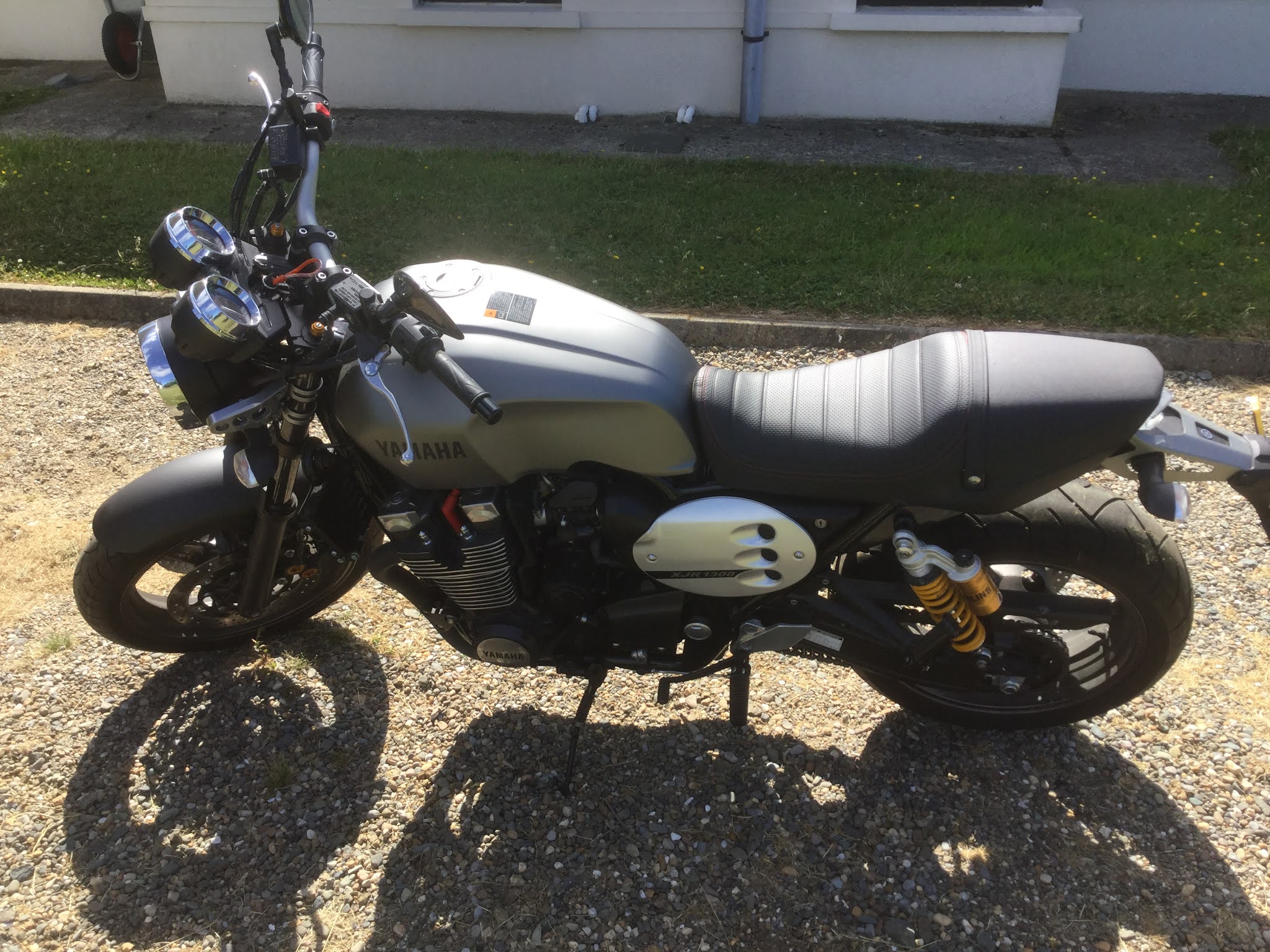
We moved from Dublin down to the “Sunny Southeast” in Co. Wexford a few years ago. A strip of driveway and a back yard became an acre of lawn. My better half never liked my café racer and nearly hit the ceiling (in glee, not despair) when I told her I was going to sell it so we could buy a new ride-on mower.
The Honda doesn’t have anywhere near as much power, but it is still fun to ride.
¸.•*´¨)✯ ¸.•*¨) ✮ ( ¸.•´✶
I was a contract writer and editor in the IT industry for many years. As such, I have lived more of my life abroad than at home. Over the years, I lived in Cyprus, Germany, Sweden, The Netherlands, and Italy, (including Rome, Naples, and Modena). I speak fluent Italian, as well as some Dutch and German. I never could get my mind (or tongue) around Swedish or Greek.
¸.•*´¨)✯ ¸.•*¨) ✮ ( ¸.•´✶
When I lived in Rome, I was working for IBM. One summer, we had a visit from a senior executive. He wanted a guided tour of the Forum during his forty-eight-hour stay. None of the English-speaking tour guides were available at the time, so my department head volunteered me as interpreter for the tour. The Italian tour guide took it as a personal affront and refused to allow me time to interpret what she was saying. In the end, I had to make up quick one-liners so we could keep up.
There is an avenue of Doric Columns parallel to Trajan’s Column. During their day they were painted with multiple colours. The tour guide took five minutes describing their intricacy, which I boiled down to, “the avenue was long and brightly coloured”. The executive raised an eyebrow but said nothing.
¸.•*´¨)✯ ¸.•*¨) ✮ ( ¸.•´✶

We are aiming for self-sufficiency when it comes to fruit and veg. Since moving to the “Sunny Southeast”, I have built eight raised beds and planted an orchard. The beds are good for spring and summer growing only, so last year a friend and myself erected a polytunnel, providing near all-year-round production.
It’s a wonder I find time to write.
¸.•*´¨)✯ ¸.•*¨) ✮ ( ¸.•´✶
I completed my first novel when I was twenty years old. It was a tome of some 220k words. Monstrous. I didn’t recognize it as such and duly sent it off to literary agents in their dozens. Back then, it was frowned upon to submit to more than one agent at a time, so I spent the best part of two years getting rejection after rejection. Needless to say, there were many years between my first completed MS and the next one.
A couple of years ago, my sister was doing a clear-out and found a dusty old copy of the MS in her attic. Of course, I had to read it, thirty-odd years later. It transpires the tome was not only monstrous in terms of size.
A wonderful story with unforgettable characters and a plot that kept me reading well into the night. I adored the way the author has captured the very essence of this era. The mythological aspect of this novel was carefully written but there is a strong sense of historical realism throughout.
Micheál Cladáin is a new author for me. I will certainly be checking out his other books at a later date.
I think this book would especially appeal to fans of Michael Hirst’s Vikings.
 | It is germane for me to manage reader expectations at this juncture. This is a blog that describes the process I follow when I write a novel. It is not a textbook designed to teach those who want to write novels: there are already far too many of them available (which just rehash existing theory). |
I suppose I started this blog because of two disparate but related events. I read a poorly written blog (yet another claiming canon over creative writing) and read a series of traditionally published works, which were unedited and poorly written.
The wheel is continually being shaved to a finer point by those who think everyone wants to write a book and they have the definitive answer, which will guarantee overnight success. All of them are blatant attempts to cash in on a shift in publication trends. It has become so easy to self-publish that the market has been swamped by those — without the requisite tools — who are in it to make a fast buck. The Fagins have all climbed on the trend in an attempt to sell their dodgy wares to those charlatans because they, too, see it as easy money.
I suppose an indication of the shift is evident in the following anecdote.
Some years ago (post search engines), I ran a search on story arc. The engine returned a handful of documents claiming to be canons on story arc theory, all of which were differently worded exponents of the three-act structure and seven-point arc. This morning I ran a search on story structure and received 104 000 documents, none of which mentioned the three-act structure and seven-point arc. I didn’t read them, of course, but attempts to refine my search with three-act and seven-point returned nothing. It wouldn’t take Sherlock Holmes to surmise that the words have changed but — on this, I would bet a year’s royalties — the message is the same.
I would be the last to claim knowledge on how to teach prospective writers, actually leaning toward the theory that the skill of novel writing cannot be taught. It does not mean being able to create sentences or having a meaningful vocabulary: those are the tools Stephen King describes. Writing a novel — at least one a reader would enjoy — is a creative process. Creativity is something that — to a degree — is either there or it isn’t. However, an ability to write does not guarantee success, in the same way, an inability to write does not preclude it. I read a book by a well-known TV personality recently, which was badly written, badly edited (if at all) and a multimillion-copy bestselling book. The number of five-star reviews (55 000 on the day of writing) proves Stephen King’s point that readers don’t care about the quality of the writing, only about the story. As it happens, in my opinion, the story wasn’t good either. It was written in the style of a prepubescent, as well as having a naïve plot, although on a much larger scale. I would have been a little ashamed to submit it as English homework.
A Technical Approach To Novel Writing documents what I do. Readers can use my methods as they see fit. I don’t claim it is the definitive process. Stephen King would poo poo my methods because they fly in the face of his own guidance. However, I wouldn’t read too much into that, because he also totally ignores his own guidance. Like Stephen King, I don’t agree with much of what he writes in On Writing either.
Basically, I will publish a series of blogs that outline the process I follow when writing a new book. The blogs will cover topics from my first thoughts until the final edit before publication. The blogs will include the following topics:
| I spent thirty-five years as an editor in the IT industry. Although technical documentation and creative writing differ immensely, the principles of editing remain the same. Writers without experience in editing should hire professional help for all aspects of the editing process. Even as a professional editor, I do recognise the need for help during the editing phase of my work and employ Holmes Editorial. |
The length of the blogs I will post over the coming month will vary. The Plotting and Editing blogs will be much longer than the writing blog.
The following are the contents:

 PerchedCrowPress