On Special

Screenshot

Until the release of Anvil in the autumn, the first two books (Hammer and Iron) are on special offer. Get both books for an amazing £3.98, less than the price of a pint.

Hammer

Get ready for an epic journey through ancient times! Follow Genonn as he embarks on a thrilling quest to deliver Lorg Mór, the Hammer of the Gods, to tribes across the straits of Pwll Ceris.

When his daughter unexpectedly joins him, the stakes are raised even higher. As Genonn grapples with conflicting duties and desires, the fate of his family and the clans hangs in the balance.

Meanwhile, Agricola questions his commander’s motives as he faces off against Queen Boudica’s mighty army. What unfolds will alter the course of history and shape the destiny of two extraordinary individuals.

Hammer is a gripping tale that blends the best elements of David Gemmell and Bernard Cornwell, making for an unforgettable historical fantasy adventure!

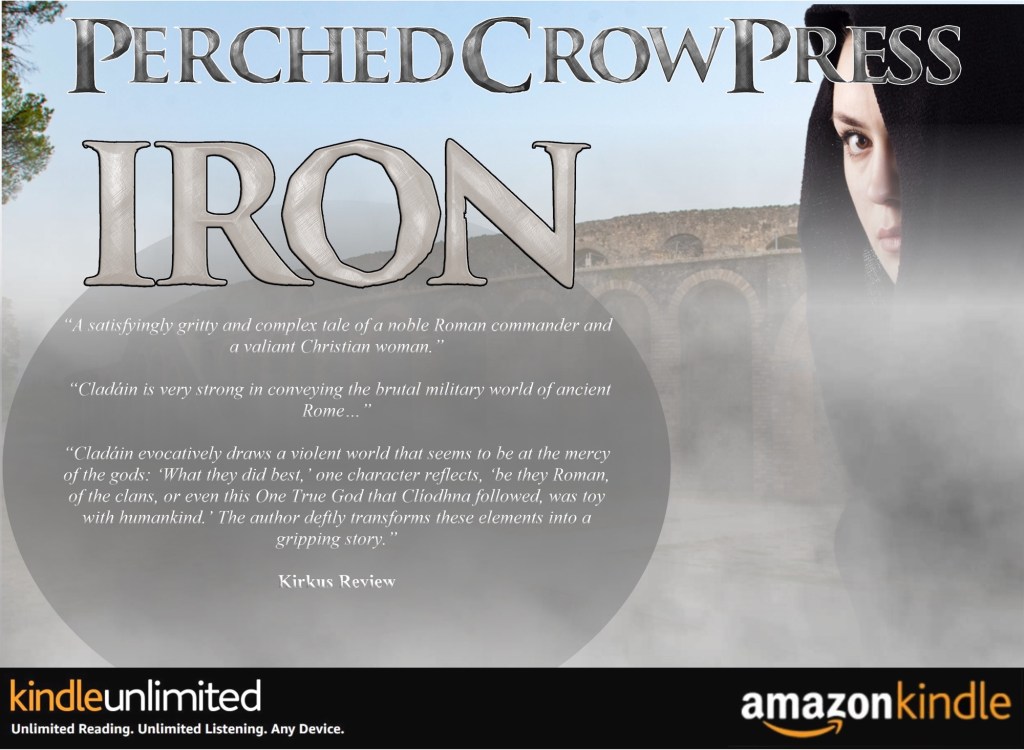
Iron

The tumultuous year of the Four Emperors is coming to an end. Rome is reeling from brutal civil war and mutiny. Praetor Agricola is summoned to the palace only to encounter his long-lost love, who he believed to be dead, fleeing through the dense fog and into the Suburra. Despite giving chase, she manages to elude him, compelling him to dispatch his second-in-command to track her down.

Meanwhile, the arrival of Gul in Rome brings distressing news, prompting Clíodhna to reluctantly agree to return to her home in Caer Leb. However, before they can depart, they are apprehended by the Praetorian Guard on charges of sedition and face the terrifying prospect of being fed to the lions in the arena.

Amidst this chaos, Mucianus, acting as Governor of Rome in Vespasian’s absence, appoints Agricola as Legate of the Legio XX Valeria Victrix, sending him to Britannia to assume command. Determined to rescue Clíodhna from captivity, Agricola resorts to deception, risking the ire of the Governor and creating powerful adversaries as he embarks on a Herculean task to secure her freedom.

Their departure from Rome sparks a perilous pursuit by relentless adversaries who will stop at nothing to ensure that Agricola and Clíodhna pay the ultimate price. As they flee for their lives, the suspense and danger escalate to a thrilling crescendo.

Anvil

It’s the year CE 77. Vespasian names Agricola as governor of Britannia.

Upon his arrival, Agricola learns of an Ordovician assault orchestrated by his nemesis, Luchar. A cavalry outpost lies in ruins, and the sons of Rome’s senators have been mercilessly slaughtered. Memories of a similar tragedy flood Agricola’s thoughts, as he recalls the brutal murder of his friend Quintus at the hands of the same Celta warrior. Fueled by a thirst for vengeance, Agricola launches a relentless campaign to wipe out the Ordovician people, spearheading the conquest of Mona and beyond…

“The author is clearly in his element bringing to life this tense world in which ‘the gap between living and dying was no more than two hand spans.’” — Kirkus review of Iron, book 2 of The Iron Between trilogy.

Links

The Iron Between.

Pre-order Anvil UK.

Pre-order Anvil US.

Coming in the autumn

Get ready for the epic conclusion in The Iron Between series, a thrilling saga of war and treachery, love and loss.

It’s the year CE 77. Vespasian names Agricola as governor of Britannia.

Upon his arrival, Agricola learns of an Ordovician assault orchestrated by his nemesis, Luchar. A cavalry outpost lies in ruins, and the sons of Rome’s senators have been mercilessly slaughtered. Memories of a similar tragedy flood Agricola’s thoughts, as he recalls the brutal murder of his friend Quintus at the hands of the same Celta warrior. Fueled by a thirst for vengeance, Agricola launches a relentless campaign to wipe out the Ordovician people, spearheading the conquest of Mona and beyond…

The author is clearly in his element bringing to life this tense world in which ‘the gap between living and dying was no more than two hand spans.’” — Kirkus review of Iron, book 2 of The Iron Between trilogy.
Excerpt

The blond giant stopped beside a large tree to listen.

The forest was as silent as a burial mound. Nothing. Not even animal noises. He smiled, happy. The stealth of his warriors through the night-shrouded underbrush was something despite their size. Quiet as mice in the granary. The twenty hand-picked fighters had to be silent, even though, in truth, creeping through the forest was the easy part. The real danger would begin when they reached the killing ground. The space cleared between the forest edge and the palisade would be well-lit by guard fires. A vigilant sentry on the ramparts could signal an end to the venture. Despite his slight misgivings, the leader had faith in his choice of warriors because of the fighters’ skill and the task’s simplicity.

Their target could not be more straightforward: the pay chest.

Simple don’t mean easy, he cautioned himself.

Surprisingly, the old marching fort beside the Viroconium Road—midway between the walled town and Londinium—was once again home to a legion. It had not seen any soldiers for several summers, and he could not know what brought them back. He knew there would be silver because Roman legions always carried silver. Predictably. They marched. They built forts. They carried silver. And they always kept it in the command tent under the legate’s cot.

Nothing simpler. Kill the sentries with archers. Climb over the wall. Kill the legate and run with the chest.

Rubbing his chin, he waited until Bran, the last of the twenty, had passed, feeling a tingling of trepidation. He didn’t want to fail. If his plans were to succeed, he needed this silver—needed something to convince his weakling of a king. Hywel had not always been weak. He’d been a strong leader for as long as the warrior could remember, ever since he’d cut the throat of Hywel’s predecessor, in point of fact.

Must be more ‘n twenty Samhains, he realised, finding the speed with which time passed humbling. No. Old age and a new bride, younger than his boy, are the reasons for Hywel’s change.

In some ways, he even understood. The old bundún was afraid of losing it all.

Now’s not the time, he thought as Bran crept past.

Knowing concentration to be critical, he cleared his mind and followed in his deputy’s wake.

Reaching the forest edge, the warrior stopped and sucked in a breath. The fort was shrouded in shadow. Where he’d expected massive guard fires, only a few braziers gave off a limited light. He could see the silhouettes of a pair of guards walking the ramparts, but they would see little or nothing in the predawn black.

They’ve become lax.

He supposed a few summers without uprisings would make the hardiest army less vigilant. He would not have expected it of the Romans, is all. He cautioned himself again because there could easily be patrols outside the fort. Scanning the ground between the trees and the walls, he could see nothing.

“Where are the archers?” he whispered, safe knowing there were no soldiers near enough to hear.

“With me, Luchar. Get about it, gaimbíní,” Bran hissed under his breath, and the warriors carrying bows edged out from under the trees and knelt in the shadows. The warrior gave them no instructions; they knew their role as well as he knew the freckles on the back of his ham-like fist.

Although it seemed longer, only moments passed before the six arrows were winging their way towards the two guards. Their deaths were as silent as the night forest. There wasn’t even the thud of a corpse hitting the sod under the ramparts.

Drawing his sword, Luchar pointed at the palisade and ran in a loping crouch. Bran arrived first, squatted with his back to the wall, and interlocked his fingers to form a sling. The warrior used the makeshift hoist to jump up and grab the top of the wall with his free hand, the height of two and a half average men above him. Showing his massive strength, he pulled himself up one-handed and flopped over the wall’s top. Holding his breath, he remained lying and scanned the ramparts for any Romans. Other than the two crumpled corpses, there were none visible.

Satisfied, Luchar untied the rope from around his waist, looped it over one of the palisade logs, and dropped it over the wall. The rope creaked as it took the weight of a warrior, and moments later, Bran’s grinning face appeared. The deputy flopped beside Luchar and scanned the fort as he had done.

Leaning over so he was close, he whispered in Bran’s ear, “I’m going to scout below. Gather the others here and wait for my signal.”

As he dropped into the fort, his experience warned him something was wrong. It was as though he could feel eyes boring into his back. Falling into a crouch and spinning, he came face to face with a Roman standing in front of a tent with his mouth so wide it was in danger of dislocation. Probably heading for the latrine trench, the last thing the man expected was to see a giant Celta landing no more than an arm’s length in front of him. 

The shock and hesitation saved Luchar’s life and his mission. Leaping forward, he swung his sword in a broad arc and heard a satisfying click as it passed through the cartilage and vessels of the man’s neck. He watched the Roman grab his throat with both hands, eyes wide, disbelieving, dying in silence, the best way when stealth was required. The man slumped in the dirt with little noise and would not rise. The warrior dropped his sword arm and turned to survey the camp. Something was still wrong.

Too few tents. 

A legion required one leather tent for each contubernium, a unit of eight men. Hundreds of such units were in a legion. That said, the warrior could not see more than five or six tents huddled around the central square—perhaps forty Legionnaires. 

Two sentries on the ramparts and five tents. We’ve been misled.

Once again dropping into a crouch, Luchar thought they’d been led into a trap. Surveying the shadows, he could see many places where legionnaires with their fearsome spears could hide, waiting for Luchar to order his warriors in. But then, why? There had been peace for many summers, so what use would there be in setting a trap?

Then he heard the whinnying of horses—one at first, followed by others.

One nag starts, and the others follow.

Running in a crouch, he made for the side of the camp where the horses were, intent on discovering what was wrong with the picture he’d jumped into.

“Someone shut that damned stallion up,” a voice called in Latin. The warrior slowed as he passed the central tent from where the call had come. There was no eagle outside, no flags, in fact, no legion insignia at all. “I told you it needed gelding.”

“Yes, Praefectus,” a voice answered from one of the other tents.

Luchar darted back into the shadows as a legionary left his tent, grumbling under his breath. He no longer needed to see where the horses were tethered to discover what was wrong with the picture. A praefectus would command a cavalry turma. There were thirty riders in a cavalry squadron. There was no legion in the marching fort—just a small unit probably in transit from Londinium to Viroconium or the opposite. A cavalry unit in transit would not be carrying a pay chest. They might have a little wealth among them, but nothing worth the massive risk he had taken climbing the walls.

With his lips pressed firmly together, he followed the legionary and found him leaning over a stallion’s front right hoof, working a stone out, and cooing to keep the horse calm.

Cooing like he’s on his farm back in Rome.

Luchar found their lack of vigilance insulting. With their lack of denarii, the warrior felt a rage begin to seeth in the pit of his gut. He hated much about his world and those who had invaded it, but nothing so much as wasted effort.

Unable to stop the anger from becoming uncontrollable, the warrior thrust his sword through the Legionnaire’s neck at the point where it joined his skull. Such was the force he used; the blade passed right through and out of the soldier’s gaping mouth. Without waiting for the soldier to fall, he freed his sword and ran back to the palisade where Bran and the others were waiting.

He motioned them down from the rampart and into a huddle when he arrived. “It’s a unit of horse, not a legion. At full strength, they would be thirty. Four are already dead, so at most, twenty-six remain.”

“What’s to do?” Bran asked.

“There’ll be reprisals for the four already dead. My gut tells me, let’s make it worthwhile. For too long, we’ve sat and watched these Romans destroy our ways. Make ’em pay, I say.” He watched the emphatic nods around the huddle. His warriors were of the same mind. “Right. Six tents. The praefectus will be alone. He’s mine. Four each for the other five tents. Quick in and out. They’ll be drowsy if not asleep, so no trouble.”

A moment later, Luchar pulled the tent flap away from the central tent. Although not lavish, the interior was comfortable, with a serviceable rug and a cot. The officer sat at a small table with his back to the opening.

“I thought I told you to shut that horse up, Quintus,” the officer said.

Luchar felt his heart skip a beat. Quintus. The namesake of Agricola’s aide, who I killed at the start of the last uprising. How strange is life?

“Quintus is no longer able to do anything,” he said.

The officer’s speed surprised Luchar. With the spatha out of reach sheathed and on his cot, the officer had his dagger out and was facing Luchar in a crouch within two heartbeats. The warrior watched the Roman tilt his head slightly at the sound of his soldiers meeting their ends. There were the sounds of struggles and the gurgling of those with slashed throats but no warning cries or sounds of an imminent rally.

“Unusual for a barbarian to speak Latin, is it not?” the officer asked with a grin.

He’s brave, so he is.

“It is. My King insisted I learned when you Southrons first came. Speech is necessary to negotiate, the King feels. Me, I’m for a more pointed approach.”

“No amount of negotiation will save you from this,” the officer said.

“I’ve twenty of my best fighters cutting your men’s throats. You think to survive, Roman.”

“Not I, but the governor will not allow this to go unpunished.”

“Frontinus failed against the Silures and Brigantes. He is no threat to me.”

“Perhaps. But he is to be replaced, and the new governor is much stronger.”

“Who?” Luchar asked, but instead of answering, the officer lunged at him.

Had he not expected it, the Roman might have managed to get an upper hand. As it was, the warrior was ready. His sword had a much longer reach than the Roman dagger, and a nonchalant flick of the wrist angled the point up to impale the officer mid-lunge. Luchar grabbed his dagger hand and pulled the man onto his sword until their noses almost touched.

“Who?” he repeated, but the Roman just grinned at him and died.

Frowning, Luchar cleaned his sword on the officer’s tunic, sheathed it, and strolled from the tent to check progress. He found Bran standing with his hands on his hips, watching the warriors drag Roman corpses from tents and dump them in an untidy pile.

“Anyone dead?” he asked.

“No. It was child’s play. They’ve been too long idle.”

“Or maybe it’s the clans too long idle.”

A short time later, Luchar stood atop the rampart with his arms crossed, surveying the bodies piled up in the central square. A single cavalry squadron and no silver other than that looted from the corpses. Thirty riders dead, and only a handful of denarii to show for it. It was true that wars had been started for less, but not by much. As much as it was on the failed mission, his mind was also on the decanus, Quintus. He wondered what the Faithe’s game might be. Was there an omen to be read from the coincidence? Would it be good or bad?

And who is this new governor?

“We’re ready to leave,” Bran said as he arrived on the rampart.

“Who said there was a legion here?” Luchar asked with a frown.

“That’d be the young lad of the King’s. Olwen,” Bran said.

“Ah. New to the world of scouting, I take it.”

“Aye. He is, too. Probably saw the sentries and decided legion without checking.”

The warrior frowned at the forest canopy where the greens were just coming to life, reflecting the early morning light. It would soon be time to move. The fort might not have seen a legion for many summers. Still, Roman units marched up and down the road continually. They didn’t have time to bury the bodies, and the crows that had already gathered in the skies above would soon attract attention.

“Gods, but Hywel is unlucky with his offspring.”

“What shall we do, Luchar?” Bran asked.

“Take their heads. No silver just ain’t good enough. And bring the horses. Them we can use.”

Krondor: The Betrayal

I used to love Feist’s fantasy novels.

When I read Magician in the early eighties, I found it thoroughly enjoyable. It remains one of my favourite fantasy novels, along with the rest of the Riftwar Saga books and the Empire Saga, co-authored by Janny Wurts. I was expecting something similar from Krondor: The Betrayal.

However, my anticipation was met with disappointment when I discovered that the Krondor series was based on a video game. The writing style, which I found to be subpar, was a stark contrast to what I had come to expect from Feist. This was further echoed in the one-star reviews on Amazon, which shared my disappointment. It’s not often that I consult Amazon reviews before reading a book, but in this case, perhaps I should have.

With my background in the video game industry, I could envision how the architects might have initially designed Krondor using storyboards with itemised lines of text—possibly resembling a bullet list. This design seems to have seeped into the supposed manuscript. The story lacks flow, and the short paragraphs appear as though they could have been a bullet list that was then given some polishing to make them more substantial. It’s regrettable that the resulting “novel” was published without the necessary editing or professional refinement, as it could have been so much more.

The end result is a narrative that feels rigid and devoid of depth, akin to a preteen’s English assignment. While Krondor might be suitable as a video game, it falls short of the immersive and engaging experience one expects from a fantasy novel. Coupled with the disappointing writing, I can confidently say this is one of the most underwhelming books I’ve encountered.

Recommendation

My rating for Krondor: The Betrayal is 1 out of 5 stars.

Given these observations, I cannot recommend this book. If you’re new to fantasy novels, you might have a better experience starting with Feist’s earlier works.

Hammer: Free for a Limited Time

“A relic is all that stands between Rome and victory!”

This award-winning book from Micheál Cladáin is free for a limited time from today.

Download an epic adventure!

Embark on a pulse-pounding journey alongside Genonn, a seasoned Druid, as he undertakes a mission that will test his limits. When rebellion erupts in Roman Britain, he is forced to make a heart-wrenching choice between his duty and the safety of his daughter.

Simultaneously, Agricola, a member of the Governor’s staff, is shocked by Suetonius’s decision to march west in the face of a looming threat from the Iceni Queen on the island’s East Coast. Is Suetonius truly unaware of the danger, or is something more sinister at play?

Prepare to be swept away on an exhilarating journey through perilous lands and witness awe-inspiring acts of heroism that will ignite your imagination. Don’t miss out on this epic tale of duty, sacrifice, and the unbreakable bonds of family.

Reviewing Iron, Kirkus hailed Hammer, the preceding volume, as: “Agricola was the hero of the thrilling military climax of the preceding volume, Hammer (2023)—each book is satisfying on its own, although there’s a rewarding sense of momentum in reading them in order.

Renowned Irish author, John De Burca called it “Hugely enjoyable.” Renowned historical novelist, Cathie Dunn called it a “…riveting read.” Renowned historical novelist Lissa Oliver wrote, “I really enjoyed this book.”

United Kingdom
United States

Hammer: Free for a Limited Time

“A relic is all that stands between Rome and victory!”

This award-winning book from Micheál Cladáin’s is free for a limited time from today.

Download an epic adventure!

Embark on a pulse-pounding journey alongside Genonn, a seasoned Druid, as he undertakes a mission that will test his limits. When rebellion erupts in Roman Britain, he is forced to make a heart-wrenching choice between his duty and the safety of his daughter.

Simultaneously, Agricola, a member of the Governor’s staff, is shocked by Suetonius’s decision to march west in the face of a looming threat from the Iceni Queen on the island’s East Coast. Is Suetonius truly unaware of the danger, or is something more sinister at play?

Prepare to be swept away on an exhilarating journey through perilous lands and witness awe-inspiring acts of heroism that will ignite your imagination. Don’t miss out on this epic tale of duty, sacrifice, and the unbreakable bonds of family.

Reviewing Iron, Kirkus hailed Hammer, the preceding volume, as: “Agricola was the hero of the thrilling military climax of the preceding volume, Hammer (2023)—each book is satisfying on its own, although there’s a rewarding sense of momentum in reading them in order.

Renowned Irish author, John De Burca called it “Hugely enjoyable.” Renowned historical novelist, Cathie Dunn called it a “…riveting read.” Renowned historical novelist Lissa Oliver wrote, “I really enjoyed this book.”

United Kingdom
United States