The Alcoholic Mercenary

Capri, Italy

The thrill of the sea spray, the wind, the bouncing and jostling of the Zodiac always excited Beni. He could think of nothing he would prefer at three in the morning. Not so his navigator, Stefano, wobbling in the front, armed with the compass, who kept waving and shouting directions when the boat veered, pushed off course by an unforgiving sea. Beni could imagine Stefano’s free hand gripping the rope so tightly his knuckle bones would be shining in the moonlight.

When they reached the open sea, and the shadow of the Sorrento coast hid Capri, the waves tried to knock Stefano out of the boat. Beni screamed at the thrill, and Stefano screamed at him to slow down. Tough on Stefano, though, because Beni had the wheel. And what a wheel. What speed. Someone told him how many knots the Zodiac could do. With no idea what knots were, he still knew that if he pulled the throttle back to the stop, he would be doing more than thirty klicks an hour, which, at sea, was a fantastic and scary feeling.

Stefano started to wave his red dimmed torch, just visible in the predawn black, when a beam of light lanced from a point at sea where no land could be. Beni eased back on the throttle and grinned. The freighter. As soon as they had slowed enough to be gently rocking in the waves, he lifted his halogen torch and flashed a response. It was a game. Scortese had told him the Guardia[i] could do nothing. They were outside Italian waters. The threat would be when they were returning.

Beni didn’t think there was much threat, even then. This was his fourth trip, and he’d seen nothing of the sbirri[ii] or the Guardia. It was as if they didn’t care. They had billions of lire’s worth of hi-tech boats resting idly in the port of Miseno. Sure, he’d listened to those engines booming across the bay. Anyone who lived around Baia had heard them. They shook buildings and made teeth rattle. Beni had never seen an interceptor, but he’d felt one often enough.

It didn’t take long to load the crates into the Zodiac. The men hanging out of a loading door in the ship’s hull held their peace. Beni knew they only spoke Russian and supposed they didn’t care if the AKs went to the correct buyer because they’d get their money either way. Ten minutes and he was again feeling the thrill of pure power. The boat’s bow lifted out of the waves like some monstrous creature from the deep, one of the spooky black and white ones from the American films he’d snuck in to see.

They’d made it into the gap between Capri and the coast when Stefano once more started to wave his torch frantically like he was trying to swat some elusive mosquito. Beni eased off the throttle and let the Zodiac come to a rest, swaying gently in the wash, the outboard quietly chugging and spitting sea spray.

‘What’s up?’

‘Can’t you hear it?’ Stefano asked, stress evident in his tone. Beni could imagine his frown, invisible in the red glow, mouth and eyes nothing but black.

Cupping his ear, he listened. Finally, he could hear a muted roar over the chugging of their engine.

‘What’s that?’ he asked.

‘That’s the Guardia interceptor. They’re coming for us.’

‘How do they know we’re here?’

‘I dunno. Radar, maybe,’ Stefano replied.

‘What are we going to do?’ Beni asked.

‘We’ll have to run for it. Hope they miss us.’

‘Are they likely to?’

‘No idea. Only one way to find out.’ Stefano’s tone was a sure indication of what he thought their chances might be. Beni knew if the light had been enough, he would see Stefano’s face etched with panic lines.

‘So, let’s find out then,’ he said.

They found out quickly.

As they raced out from their cover, someone flicked a switch, and the interceptor glared at them with a halogen beam, which made daylight appear wherever it touched. Tall explosions of water in front of the Zodiac were accompanied by the dub-dub-dub of heavy machine gunfire and a mechanical voice ordering them to heave to. They couldn’t argue with the twin guns mounted to the front of the boat, which would tear the Zodiac into plastic strips while churning Stefano and Beni into shark bait. Beni turned the engine off and waited calmly.

He had nothing to fear.

Before long, a Zodiac like theirs appeared in the light thrown by the interceptor. It was smaller, and Beni guessed it had been launched off the other vessel. There were Guardia in it, pointing guns at them.

‘Get your hands up.’

He could see Stefano shaking. Neither of them had been arrested before, but Beni knew he would not spend more than a single night in custody because Beni made sure to give his tame sbirro the odd scrap of information. His insurance policy. He never told the cop anything of importance, just gossip, but the man was about as bright as a beachball and took it all as though it was Christmas.

Less than ten minutes later, they were pulling themselves up the boarding ladder into the Guardia’s boat. The boat impressed Beni. He couldn’t ignore the beauty of its hard lines and massive engines, throbbing right into his guts, making his teeth ache. Jumping onto the deck, he found a man standing there wearing chinos and a summer jacket. The man had his arms crossed and was grinning.

‘Where’s your uniform?’ Beni asked before he could stop himself.

‘Not Guardia. I’m a sbirro from Pozzuoli. Just observing here.’

‘What? Like watching the boat crew? That’s a bit creepy, isn’t it?’

‘What’s your name, guaglio?’ the man asked, his accent causing Beni to frown. Most cops he dealt with were not from around Napoli. In fact, they tended to be from north of Rome – way north of Rome.

‘You a local?’

‘Baia born and bred. Why’d you ask?’

‘No reason. Curiosity.’

‘So, what’s your name, kid?’

‘Beni Di Cuma.’

The cop smiled and nodded, making like he was on Beni’s side. The idiot thought Beni would be swayed by his false friendship because they were paisan[iii]. He didn’t need any buddies in the cops. He had his sbirro in Pozzuoli, who worked for the Secret Service. His wannabe handler. The one who would have the power to keep him out of La Casa. Beni would be eating lunch in Pescatore’s come midday.

‘This’ll warm you up,’ the sbirro offered his hipflask. Beni took a swig before handing it to Stefano.

‘Who’d you work for, Beni? My guess is the Scortese crew.’

Beni shrugged and turned to look at the silhouette of Capri, quickly receding as they headed into port. He thought the cop knew well enough. He thought they all knew. Did they not talk to each other? He supposed he shouldn’t be surprised. All the different types of cops Naples had, and they all thought they were better than the others. The Gatti Neri[iv], the Guardia, the sbirri, all thought the others should bow to them. Never mind the Secret Service, who – chosen by God himself – bowed to no one.

Available for pre-order. All profits go to the Irish Red Cross Ukraine appeal.


[i] Guardia di Finanza – Italy’s customs and excise law enforcement agency, responsible for border protection as well as customs.

[ii] Sbirro – Italian slang. Closest English (Universal) would be a cop. Plural form would be sbirri.

[iii] Paisan – Neapolitan slang. Peasant. Used to mean compatriots.

[iv] Gatti Neri – Neapolitan. Black Cats. Nickname for the Carabinieri, Italy’s military police. See notes.

Planned Release Schedule

Spring:

The Alcoholic Mercenary is the story of Andrea, ex-para, reformed alcoholic, servant to the most powerful man in Southern Italy, if not the whole peninsular.

Can he keep the grappa at bay, or will unrequited love and murder force him back?

Summer:

Milesian Brother of Justice is the story of Genonn, the disillusioned Druid who has decided to fight for the rights of the common people.

The Battle of Gairech has left the Five Kingdoms in turmoil and his desire to do good is stretched beyond breaking.

Autumn:

The Reluctant Mother is the story of Anna Maria, mother of twin boys, who is determined not to take on the mantle of Matriarch of the clan after her husband’s murder.

Will she succeed in keeping the temptation of rich rewards at bay?

Winter:

Milesian Suppression (working title) is the story of how Genonn defends Druid Island and the Five Kingdoms from the long-feared Roman invasion.

Be Your Character

I read “be your character” somewhere, in one of the many articles I devour. It seems a little blasé and unrealistic. How can I be my character when I write pre-Christian Irish historical fantasy? My characters spent their lives chopping off heads, stealing and raping, drinking and debauching. If I took a method acting approach to being my character, I would not last too long this side of high walls with razor wire on top.

But what did the author really mean? I am sure it wasn’t that I had to put on some plaid trouse, get out my broadsword, and head into the hills of Ireland looking for a settlement to rob. So, what? In the end, it comes down to what, I think, is a simple list. Give characters realism; make them relatable; make them individual; give them conflict.

Realism

Characters must be realistic. Readers need to invest in them and believe in them. So how do we writers achieve that? There are several ways to make characters realistic. Not least would be giving them fallibility. Let them make mistakes. There is nothing more real than falling over occasionally. No one goes through life error free. Take Gandalf, he went off and left Frodo alone with the ring, when he should have run for the hills, Frodo in tow, as soon as he suspected. Then he led them into the mines of Moria, knowing there was something dreadful in them, but being too fallible to go against the wishes of the fellowship.

Make them complex. There is nothing less real than a one-dimensional character. There needs to be layers that the reader can discover through the journey the character is making: their arc. Even the villains need the layers. Take Sergeant Troy in Far From the Madding Crowd; pure villain, but multi-layered, evidenced by his attempted suicide.

Relatable

The reader needs to feel a connection to the characters. Even the bad ones need to garner a little sympathy, or some understanding. The reader needs to be able to say, “yes, that is an understandable reaction”, even when it is not something they would condone. This gives characters their humanity. The old Alexander Pope-ism about erring being a trait of humanity. Angus Thermopyle from Donaldson’s Gap series is a good example. The way he treats Morn Hyland is despicable, evil incarnate, for want of a better cliché. But the reader is given the backstory to Thermopyle’s evil, which, although it doesn’t excuse his actions, it does go some way towards explaining them.

Individuality

Each character needs to be their own person. They need to have their quirks and their habits: a certain nuance in speech; a particular tic; a quaint turn of phrase: something that is unique to them. Henry Treece’s Heracles in Jason is a good example. Treece made Heracles a homosexual eunuch, which was a particularly unique take on the character, giving the story of Jason and the Argonauts another dimension. A slightly less well-known character, at least for now, is Inspector Laconto from the Time to Say Goodnight series: Laconto smokes Gauloises at murder scenes because he can’t stand the smell of death, which is a unique trait for a copper.

Conflict

Characters need to have troubles to overcome to generate interest in them. If they move from scene to scene without defeating any demons, then the story will be flat. It does not matter what those demons are, the inner demons of a character of literary fiction or the fire breathing type from epic fantasy, conflict keeps the interest of the reader and, therefore, the pages turning.

So, what do I think?

Can I be my character? No. As covered earlier, I would end up in lock-up, never mind lockdown. Can I make them real, give them personal traits, put them within touching distance of the reader, give them obstacles to overcome before they reach their goals? Yes and yes again.

Micheál

On the Origins of My Species

I am often asked why I chose to write in a genre where it is notoriously difficult to succeed. I still have nightmares about the reactions I received for a piece I submitted to a writer’s group four years ago: “stop this nonsense, stick to writing crime”, being the essence of the message. I cannot! Historical Fantasy is in my blood!

Why historical fantasy? I suppose the simple answer is evolution.

My father was educated in the classical grammar school system back in the nineteen-fifties. As such, bedtime stories in our house tended to be read from a tome of Greek mythology. My formative years were filled with hydras and Heracles, Gorgons and flying horses, minotaurs and one-eyed giants.

Small wonder that when I graduated from listening to reading, Henry Treece was high on my agenda. Next to The Lion the Witch and the Wardrobe, I invariably had a copy of one of Henry’s Viking sagas. And from there, to the adult versions of Jason, Electra and the Green Man. Not to mention the works of Mary Renault, notably The Bull from the Sea, The King Must Die and The Praise Singer. And then the twentieth century ended with David Gemmell’s Lion of Macedon and later in the noughties, The Troy series.

The thing I loved most about the works of Treece and Renault, and later Gemmell’s Troy, was taking away the magic and monsters and making the stories (for me at least) more believable. Don’t misunderstand me, I do love a dragon or two, when appropriate, but I also love putting humanity into the ancient myths. I love that Treece’s Heracles was a Eunuch and Gemmell’s Odysseus was a storyteller with a vivid imagination.

But why Irish Myths and Legends?

I think it is probably because the Irish myths are there, within touching distance. They are not so distant in time as the Classical myths of Greece and Rome: Conaire Mór was high king when Caesar was invading Britain; Queen Medb was cattle rustling just before the birth of Christ; Conor Mac Nessa’s head exploded at news of Christ’s crucifixion. For me, that places them more in the historical aspect of the genre than the fantastical.

So, my evolution leaves me with a question; a question that will not recede.

If the history of the tribes of Ireland had not been a verbal tradition, passed from druid to druid, but a written one, would we still have the Irish sagas firmly stuck into the Mythological pigeonhole they are in?

I think not.

Micheál May 2020

Lockdown Learning

I recently attended a virtual retreat with Conor Kostick organized by the Irish Writer’s Centre. I think I can safely cliché, without fear of contradiction, that it was an overwhelming success.

Of course, the IWC are famous for their support of the writing community, both here and across the pond, so one expects great things from them. However, dealing with the adversity of holding a retreat remotely must have been a challenge. Video linking to the rescue. Even as little as five years ago, it would not have worked, but today teleconnection is a marvel of modern science (to continue with the clichés) and, I felt, had only a marginal impact.

The format was strong. Forty minutes of Conor imparting his limitless wisdom, followed by readings and feedback on the group’s WIPs. Two hours each day, for two weeks.

I don’t think it is necessary to laud Conor’s skills, which are evident in his multiple awards and literary successes, both in fiction and non-fiction. As a mentor, I found Conor to be generous with his knowledge, patient, and forgiving of the faux pas inevitable in a literary student. I learnt a great deal over the two weeks and feel improved by the experience.

Even at a social level, the retreat was a success. I met a bunch of extremely talented writers and have no doubt that, given time, some (if not all) will become tours de force in their chosen genres.

My takeaway (or perhaps giveaway), if you find yourself with the opportunity to attend a writer’s retreat with Conor Kostick, grab it. You will love the experience.

Coming 31st August

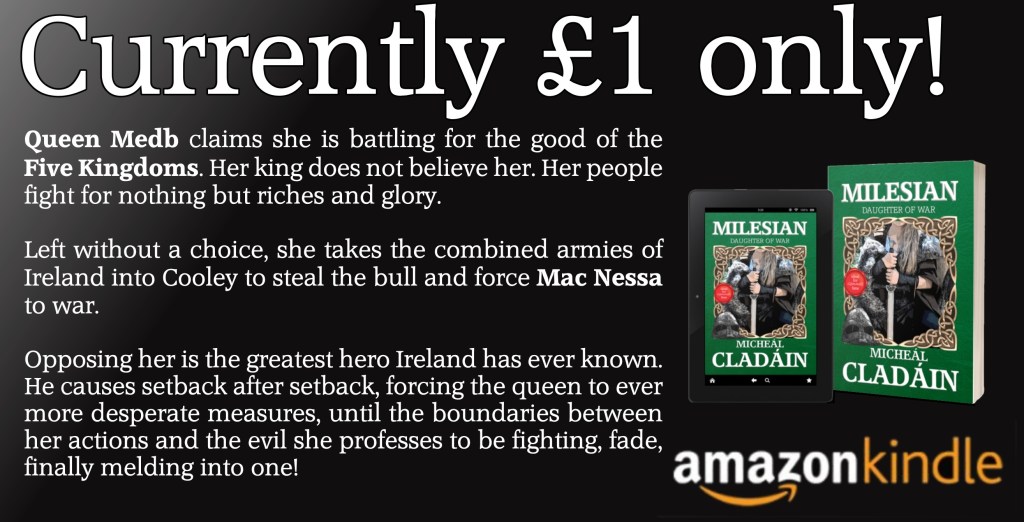
Milesian Daughter of War

The Romans are coming.

The Five Kingdoms are fractious and unprepared.

The Daughter of War will countenance nothing else.

Queen Medb has been unsuccessful in her attempts to punish Conor Mac Nessa for raping her on the banks of the Boyne. Her vengeance has left a trail of bodies across the Five Kingdoms. Rather than admit defeat, the Queen pressures the kings into mustering their armies to bring war to the Ulaid. Her professed target, the prize bull, Donn Cuailnge, her actual target, the head of Mac Nessa, king of the Ulaid.

“It takes a great deal of courage to pick up something so well-loved as the Irish sagas of the Red Branch and the Milesian Kings and dust them off. But the author has managed to do this very well.”

 David Ebsworth, renowned historical author.

Meantime, get Milesian Son of Light at the knockdown £0.99: https://www.amazon.co.uk/dp/B07QH1JY48

Release Schedule (revised)

Revised release schedule

pippo144's avatarPerchedCrowPress

Here’s the PH Publishing planned release schedule for 2020, the year of perfect vision.

A Prelude to War

A Prelude to War, The Milesians was released on February 28th. It is the tale of a king who is too weak to rule, a queen who is defiled by one from whom she sought succor and a hero who crosses boundaries to the extent he loses all control.

Available at: www.amazon.com/dp/B08428DHLS

The Hidden Syndicate

The Hidden Syndicate is due for release on April 30th. It is the complete tale of Inspector Izzo and Archie Moses all rolled into one. There are new bits and the previous three books have been heavily edited.

Milesian Daughter of War

Milesian Daughter of War is due for release August 30th. Queen Medb has tried everything to get her revenge on King Conor. All has failed, so now she has decided on war. She fabricates…

View original post 155 more words

Hot New Release

A Prelude to War

Conaire is made high king because the Elder Council want a peaceful kingdom. They fear invasion by the horde from the south, the Romans, but their manipulations weaken the Five Kingdoms and war does come to Ireland, but from an unexpected place. The Five Kingdoms are saved by the Red Branch warriors, but not before The Peaceful King is killed by the invaders.

When Conaire is killed, the Five Kingdoms are in turmoil. Conor Mac Nessa, king of The Ulaid, tries everything in his repertoire of evil skills to gain the high kingship but he is opposed by Queen Medb, the Warrior Queen of Connacht.

Their rivalry gives birth to a hero, The Hound of Ulster.

Available at:

http://www.amazon.com/dp/B08428DHLS