The year of the FourEmperors is drawing to a close. Rome has been through brutal civil war and mutiny.
PraetorAgricola is called to the palace and sees his first love—a woman he thought to be long dead—running through the fog and into the Suburra. Giving chase proves futile, and he sends his second-in-command to find her.
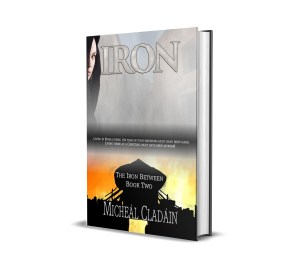
When Gul arrives in Rome with distressing news, Clíodhna has no choice but to agree to return to her home in Caer Leb. Before they leave, however, they are arrested by the Praetorian Guard for sedition and will face lions in the arena.
Mucianus, appointed Governor of Rome in Vespasian’s absence, appoints Agricola as Legate of the Legio XX Valeria Victrix, dispatching him to Britannia to take command.
On hearing of Clíodhna’s arrest, Agricola lies to the Governor to free her from the clutches of the Praetorian Guard, creating enemies and planting a Sisyphus-sized ball before him, which he must roll up a Palatine-sized hill to return her home.
Leaving Rome sees them chased by enemies who will do everything possible to ensure Agricola and Clíodhna pay with their lives.
Agricola—A Roman soldier and politician who conquered Northern Britain and Wales. Born to a political family of senatorial rank in France, Agricola began his military career as a Banded Tribune under Governor Gaius Suetonius Paulinus. Tacitus claims Agricola invaded Ireland, the central premise of The Iron Between trilogy.
Suetonius—Gaius Suetonius Paulinus, known in the histories as Suetonius–not to be confused with the historian of the same name–was governor of Britannia during the Boudican revolt. He is most known for defeating Boudica’s army despite overwhelming odds in favour of the Iceni queen.
Catus Decianus—The Procurator of Britannia during the Boudican revolt; when Nero ordered an investigation into the cause of the rebellion, Decianus fled to Gaul, providing this author with the premise for Hammer, the first book in The Iron Between trilogy.
Domitian—The youngest son of Emperor Vespasian; when Vespasian was declared emperor, Domitian was in Rome and seemed to have taken some responsibility for the state’s government.
Mucianus—The man Vespasian nominated as his deputy during his absence, possibly causing friction with his youngest son, who had assumed the role.
Other Main Characters
Quintus—A fictional Tribune who is my right-hand man for Agricola.
Sucaria—A druidess of the Menapii clan from Gaul who seeks revenge for her son’s death during the Boudican uprising.
Clíodhna—A Christian caught in Rome during the year of the four emperors. On hearing of her father (Genonn’s death), she must return to Ynys Môn, but events overtake her.
Genonn—A druid and father of Clíodhna. When civil war breaks out in Rome, Genonn sets off to rescue his daughter, despite having no idea how.
Fedelm—A druidess, leader of the Elder Council on Ynys Môn, wife of Genonn and mother of Clíodhna.
Congratulations to our authors, John De Búrca and Micheál Cladáin, on their double-publication day.
The Music of Swords
It tells the tale of how the fearsome Síor Feargach comes into being. We can’t deny our bias, but neither can we ignore the sheer mastery of our very own storyteller, John De Búrca. The Music of Swords is a masterpiece.
It tells the tale of a young Irish woman stranded in Rome during the year of the four emperors. It was a time of civil war and murder. It was a time when Christians were fed to the lions to appease the masses and take their minds off their hunger.
As a great deal for publication day, get the first book in The Iron Between series for free. A celebration of all that’s great in the Irish Historical Fiction scene—The Last Hammer.
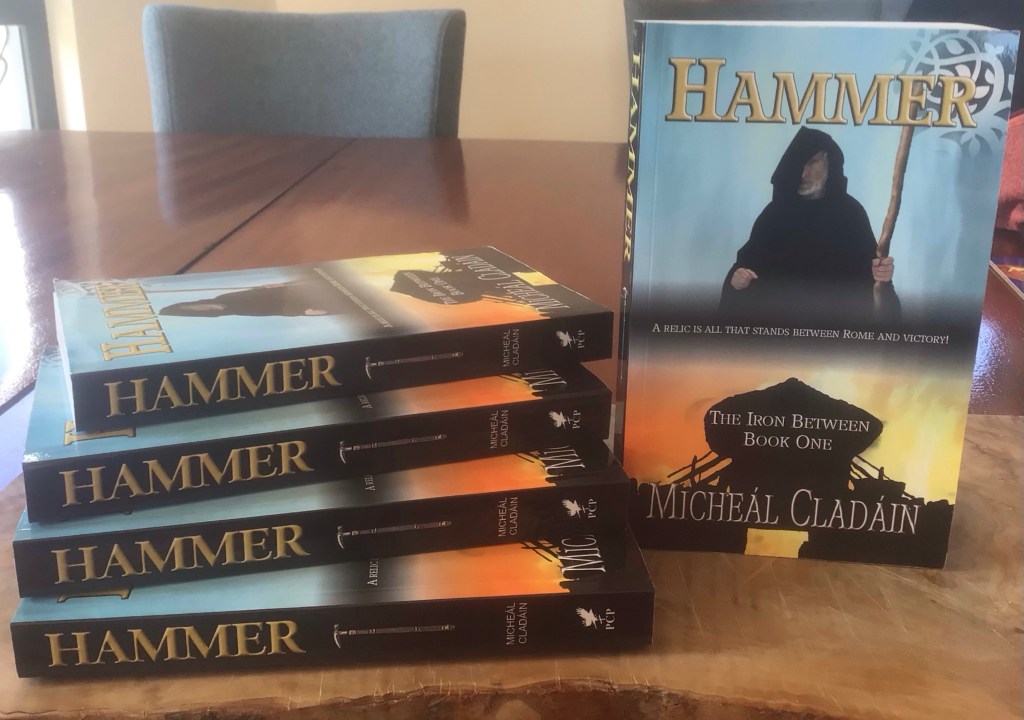
I must admit I’m not overly familiar with the period of the Roman invasion of the British Isles (other than through Nancy Jardine’s fabulous novels), and even less so with the politics of the regional tribes across the isles, but you don’t need much knowledge of it in order to understand the intriguing plot of Hammer.
We meet Genonn, an ageing druid who wishes for nothing more complicated than retire to the Cuala Mountains (modern day Wicklow – a stunning area!) to live out the rest of his days in peace. But first, he has to track down a warrior, Oengus, accused of killing a clan chief’s two sons 10 years earlier. When he finds him, he discovers that Oengus carries with him the Hammer of the Gods, Lorg Mór, stolen when the boys were killed. Was it proof of Oengus’ guilt?
After a decade of absence, the men return to meet the Elders who are now led by the former wife of Genonn, the mother of his daughter, Cliodhna. The Elders send him to the tribes of what is now south-eastern England to deliver Lorg Mór to Boudica, to help them to victory – and to suss out what these Romans are up to.
Along the way, we have murder, with dangers lurking everywhere as tribes and enemies mistrust each other. We watch Boudica’s triumphs before her final battle, Roman advances, personal betrayal, and – lastly – Genonn’s revenge.
Told from the points of view of Genonn, and the Roman Agricola, we discover different sides of the conflict that erased many of the ancient British tribes, killing or assimilating them. Not only that, but the ancient ways of life are threatened.
Hammer is a story full of tension. The pace is a little slow to start with, but picks up soon enough when it sends us on our way. Unexpected twists, changes in loyalty, and a few surprises make this a riveting read. You’ll find intrigues galore, and not just political. Personal vendettas, infiltration, and deception keep you turning the (virtual) pages.
The characters are clearly defined in their roles, but are often able to look outside their own world to see how the advance of the Roman armies change life in the British Isles beyond any recognition. It is also a time of change in religions, with the old Celtic Gods succumbing to the threat of the Roman Gods – and, in addition, the new movement surrounding the so-called Son of the One True God. A melting pot of trouble!
A gripping adventure, very well researched and written, Hammer is a must-read for fans of historical fiction set in ancient times. Highly recommended.






 PerchedCrowPress