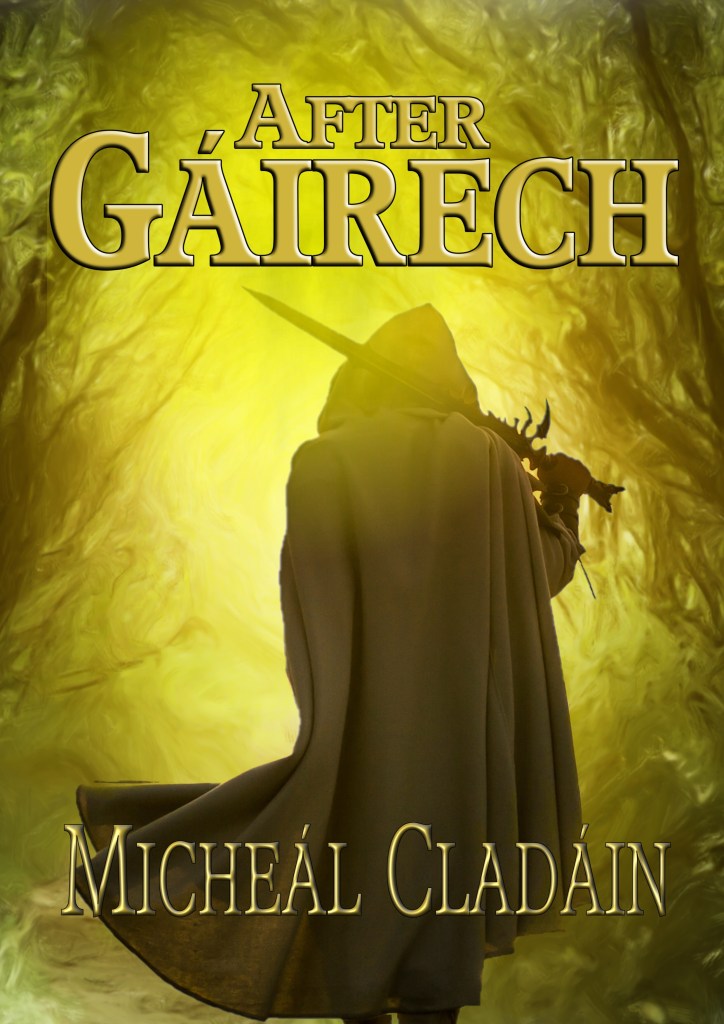
After Gáirech — Cover
Publishing Services
The author sets the stage in Renaissance Florence in 1584, where a poignant question looms over Prince Vincenzo Gonzaga of Mantua’s virility. In a bid to secure his marriage into the Medici family, Gonzaga is compelled to prove his ability to father children. In a twist of Medici infamy, an orphan girl, Giulia, is chosen by their minister to be the one to end the rumours. Uncertain of the magnitude of her sacrifice, Giulia is promised a substantial dowry and a husband. Reluctantly, she agrees, and her journey begins, under the watchful eye of the Medici’s Minister, Vinta.
Mezzacappa’s The Maiden of Florence is a masterful blend of historical events and fiction. With her exceptional skill as a wordsmith, the author weaves a powerful narrative that seamlessly merges the historical and the fictional. The novel incorporates significant events from Renaissance Italy, such as the political intrigues of the Medici family and the societal norms of the time. Having delved into numerous works of fiction set in Renaissance Italy, I can confidently say that this beautifully crafted story stands out.
The author’s dedication to research is commendable, and it shines through in the narrative. Yet, she deftly avoids the common pitfall of overwhelming the reader with excessive information, keeping the story engaging and intriguing.
I have no issue with awarding the novel 5/5 stars. The author’s skillful blending of history and fiction, the compelling narrative, and the well-developed characters all contribute to making this a standout novel in the historical fiction genre. I highly recommend it to anyone interested in Renaissance Italy or historical fiction in general.
For some reason, this chapter caused excitement in the web serialization of A Prelude to War.
Check it out and see if you can figure out why. Click me.
Medb was propped up on one elbow, watching the rise and fall of Ailill’s chest as he slept. She could not sleep. The following day’s events weighed too heavily on her mind and heart. Six years had passed since the death of the High King—six years since the last time she had seen Mac Nessa. She was not looking forward to seeing him again. The last time she saw the king of Ulster, he had been doing up his triús after raping her.
Ailill still did not know.
The following day, her husband would be in the feast hall with the other kings and the chieftains of the Five Kingdoms would arrive from far and wide. The Assembly would receive proposals for a new High King. The Elder Council had not found a suitable candidate in opposition to Ulster. There would be some half-hearted nominations, probably arranged by Mac Nessa to lend the farce an element of authenticity, but the main thrust would be behind a proposal for Ulster. There would be no dissent, and then the kings would vote.
The chieftains believed him to be a strong man.
The chieftains believed him to be a fair man.
Medb knew him for what he was. Not a protector of the weak but a defiler. A man who uses power to get what he wants. A man who wants to be High King because it will make him richer than he already is. A man who does not believe in any other’s ability to rule. A man whom Medb knew was the puppet of a druid; only he was too arrogant to see it or believe it.
Ailill needed to show strength.
The Assembly required a unanimous vote to elect a High King. Her husband needed to veto the proposal, and she was unsure he had what it would take. She needed Ailill to stand up to Ulster’s scheming. She thought she needed to give him an incentive. Through no fault of his own, Ailill did not understand why Mac Nessa should not be High King. Despite saying he would not vote for him, Medb knew her husband would yield if the pressure became too much.
She could think of only one thing to incite him.
The queen did not want to tell Ailill what had happened on the banks of the Boyne six years before. It was not that she was protecting Mac Nessa, but Ailill. Her husband had a strong heart and was a good man, but he was no warrior. If he went up against him, the king of Ulster would crush Ailill, and Medb did not want to lose another of her men. Mac Nessa would not wield the sword, not the fat king. One of his champions would kill Ailill. Conall or Fergus would do it in good faith, or perhaps the new one, the so-called Hound of Chulainn.
Leaning over, Medb kissed her husband’s brow and gently stroked his face. He came awake slowly. His dreams seemed good because his eyes smiled as he looked at his wife.
“Medb, what is it?”
“We need to talk about tomorrow.”
“I know what I am to do. I must oppose the proposal of Mac Nessa for High King,” Ailill sighed and rolled over with his back to Medb.
“Yes, that is true, but I think it is time you knew why you need to oppose him.”
Ailill turned back and propped himself on his elbow. Medb could see a slight look of confusion clouding his face. He thought Mac Nessa’s part in their son’s death was why Medb was so against the king of Ulster. He had accepted the story of the bruise in the river without question. In some ways, his naiveté had hurt her as much as the pain in her cheek had.
“It is not then because he executed Mane?”
“The humiliation he put our son through should be enough for the people to know he would make a bad High King, but no, it is worse than that.”
“What could be worse, Medb, than the loss of a son?”
“It is not worse than the loss of a son. It is worse than the humiliation of a son. Do you recall when a log struck me while washing in the Boyne?”
Ailill nodded. Medb could see the cloudiness of his face was becoming worse. She suspected he knew deep down what was to come. Perhaps he had not been wholly convinced when she first told him about being struck by a log. Now she watched doubts surfacing in a face too innocent to hide his true feelings.
“It was not a log that gave me the bruise,” she said, trying to build up the courage to tell her husband and ready herself to prevent him from reacting in a way that would get him killed.
“What do you mean, not a log?”
“I went to the secluded clearing, where the river runs through, like you told me. I was lying with my head on the bank, and Mac Nessa surprised me.”
“Surprised you how?”
“He said he wanted to barter for our son’s life. I refused, and so he struck me. When I awoke, he was on top of me—”
“You mean…”
“Yes, Ailill. Mac Nessa took by force what I would not agree to give him. He raped me.”
Medb watched her husband’s face take on a rigidity before becoming suffused with anger. She watched his naked torso as it became red with the heat of his rage. As he tensed, ready to leap from the bed, Medb threw her arms around his waist.
“No, Ailill, that is not the way. His men will crush you, and I cannot stand to lose you either.”
“Get off me, woman! You think me weak? You think I will stand by and watch my woman defiled by the likes of Ulster?”
“No, Ailill, but think about what you mean to do. He has Conall and Fergus and that new boy with the dead eyes. You are no match for them; they are born killers. Your strength lies in other areas.”
“I am not a coward, Medb.”
“No one thinks you are a coward, Ailill.”
“That is not true. The other kings think my wife governs me. They laugh at me behind my back. They think me not only a coward but weak.”
“Let them laugh, Ailill. Mesgegra and Dáire are weak. A fat fool governs them, who, in turn, is governed by an old man. Better a strong woman than a fat fool, surely? Where will I be if an Ulster champion kills you? We must be wily and do this thing cleverly. We cannot just run at him with a spear and hope to succeed. Please, Ailill, you must trust me in this.”
Slowly, Medb could feel the tension of imminent battle ease out of her husband. As she talked, he began to accept the wisdom of her words and relax into the necessity of a discussion.
“I must do this,” he persisted, but Medb could feel the doubt beginning to gain the upper hand.
“We will avenge ourselves on him, but we will do it in a way that means we will not be hurt, and none in the Five Kingdoms will know it was us.”
“But how?” Ailill slumped back into the hides of the bed, ready to listen to reason.
“We will hurt him through wiles. We will take everything from him with our superior cunning. And when that is done, we will crush him like the worm he is.”
“And where do you think we should begin this destruction?”
“We will begin with his son, Lugaid.”
Medb could see that she had yet to convince her husband. Ailill shook his head in confusion. He could not see where Medb’s mind was taking her. She admitted the boy was a youth with his head in the clouds, not a warrior or a politician. She read in his expression that Ailill was wondering how they could hope to use him in a fight against his father unless they just killed him. Undoubtedly, he thought Ulster would shrug off anything that happened to Lugaid with a laugh and a determination to get a stronger son.
“Lugaid is weak and can be manipulated. He is a dreamer, not a fighter,” she said.
“But how will we manipulate him?”
“We can think about that as soon as we have him where he can do the most damage.”
“And where is that, my queen?”
“We should convince the Assembly of Kings to make him High King.”
***
The following day, tempers were running high in the feast hall of Temuir. Kathvar knew that while the Five Kingdoms remained divided by lack of a High King, they were at significant risk. The druid had warned them of the gathering Roman storm. The small men from beyond the southern mountains had already subjugated the tribes of Gaul and had twice invaded Alba. It would only be a matter of time before they returned for good. And then Ériu, too, would be vulnerable. Kathvar was convinced he was the only man in the Five Kingdoms who recognized the threat. Mac Nessa paid lip service to the druid’s fears, but that was because he saw it as his way to gain the throne in Temuir.
“And why can we not agree on Mac Nessa?” the druid asked again.
He had put forward the king of Ulster as the best candidate after the death of Connery six years before. He had been proposing Mac Nessa since and was running the risk of expulsion from the council because he was present at the Assembly of Kings against their express wishes. The elders felt the choice needed to rest with the people, as represented by the chieftains. Most elders felt that they had intervened on too many occasions. It was time for the kingdoms to decide their fate.
“The druids have said no. Mac Nessa is not a worthy king,” Mesgegra, king of Leinster, said. “He conspired with Nuadu to kill Eterscel and then tried to kill Connery long before any Britons arrived on our shores.”
“That is conjecture, Mesgegra. Mac Nessa’s part in that coup was only ever in the mind of the late High King,” Kathvar argued, ignoring the frown of Conall and Fergus, who had both been directly affected by Ulster’s plotting.
***
Ulster’s king listened to the damning words but said nothing. The morning was a charade the druid had orchestrated to convince the chieftains the vote was legitimate. Only the kings had a vote in the election. However, letting the chieftains at the Assembly know it was all for show would be madness. The chieftains needed to believe they were represented by their kings, however far from reality.
“Still, the druids have made their wishes known.”
“And what do I look like to you?” Kathvar asked with as much scorn as he could muster. “Am I not a druid?”
Unlike the rest of the elders, Kathvar did not think the people were sound enough to manage their affairs. The previous Taidle Ulad had been of the same mind, but the reaver cut off his head.
***
“You are more Mac Nessa’s man than a druid of the council,” Ailill said, beginning to tire of the game.
Medb had calculated Ailill’s interjection to incite a reaction from the crowd, and it did not fail. The kings and the chieftains in the hall all started to talk at once. The king of Connacht was breaching etiquette by suggesting Kathvar was anything other than an impartial witness. It did not matter how valid the claim might be. The interference of the druids was not something anyone should raise during an Assembly of Kings.
As each chieftain raised their voice, the noise became a cacophony. Ailill sat calmly in his place with a smile on his face. Medb had predicted this occurrence down to the slowly rising voices.
Ailill smiled at the noise, happy in his seat at the end of the table furthest from Mac Nessa. It was the place with the least honor, but Ailill did not mind. Medb and he had known what honor Ulster would give him. His place at the table would not lessen his satisfaction at having questioned the process.
Ailill could not look at Ulster. If he were to look at Mac Nessa, he would be unable to keep his face neutral. Whatever else he might be, Ulster was paranoid. He would immediately suspect what any ill looks from Ailill would mean. He would assume that Medb had finally told their shared secret, which neither had agreed to keep but both needed to keep. At least the king of Ulster would have assumed. He needed Medb to keep that secret because had she not, he would have incurred the wrath of the Five Kingdoms. Mac Nessa would not react in the feast hall. He would not risk the secret Ailill exposing the secret in front of the kings and chieftains. He would do nothing openly, but an assassin would be dispatched at night to provide the king of Connacht with a new smile.
“I would like to make a proposal,” Ailill shouted to be heard.
The noise stopped abruptly.
The kings and chieftains all looked at him with surprise. Ailill was not supposed to make proposals. The election was supposed to have already been decided. For him to first throw the process into question and then make a proposal was, at the very least, a strange turn of events.
“Who?” Mac Nessa asked with a smirk. “It cannot be you, Connacht, who does not even rule in his own kingdom.”
There was a hiss of indrawn breath as the men in the feast hall now expected Ailill to take offense. However, the king of Connacht had been well prepared by his wife and let the words of Ulster wash over him.
“No, no. I am too old to accept such a responsibility. No, I was thinking of someone much younger.”
“Who, man? Spit it out!”
“I was thinking of your son, Lugaid.”
***
The chieftains held their breath as if a sudden backdraft had stolen the air from the feast hall. They each wanted to laugh and tell Ailill he was mad, that it would never work, but they could not. They could not because it was not mad, and it probably would work. As the seconds passed, they each began to wonder why they had not thought of it sooner.
Mac Nessa sat in silence with the other men in the feast hall. He was thinking the same thing as the others present. Why did I not think of it before? With that weakling as High King, I can rule from the comfort of my roundhouse in Emain Macha.
“Are there any objections?” Kathvar asked the assembled kings. They shook their heads. None could think of anything to say.
“Do any chieftains have an issue to raise with the proposal?” The chieftains also shook their heads. “We will vote. All in favor of Lugaid for High King, raise your right hand.” The four kings each raised their hand. The chieftains began to cheer and stamp their feet, falling into the mood of the Assembly with fervor.
***
Mac Nessa and Kathvar had adjourned to the king’s roundhouse. The druid poured them each a cup of mead. His expression was contemplative as he handed the king his cup.
“Do you think it will work?” the king asked.
Kathvar shrugged and nodded. He could think of nothing that would stand in the way of Ulster ruling the Five Kingdoms with his weakling of a son as his puppet.
“It does not matter what I think now, though, sire. It is done.”
“There are ways around that, Kathvar, as you well know.”
“There is no need for violence. I would have raised an objection during the Assembly if I thought it would not work. No, I do not think Lugaid will be interested in ruling the Five Kingdoms and will welcome your support and guidance. Nothing could be easier than controlling the rule of a fop.”
“The Hound is his foster father. Do you think that might cause an issue?”
“The Hound is your man, sire. I do not think he will present any problems.”
“Why did Ailill propose Lugaid?”
“I think that Connacht has finally had enough of listening to his wife. He stood up for himself for once. I would surmise that he thought suggesting Lugaid would circumvent your ambitions. In many ways, it has, but only to the outsider looking in,” the druid smiled.
“I must admit, Kathvar. I never thought I would rule the Five Kingdoms as a puppeteer.”

We are releasing A Prelude to War as a web serialisation on Royal Road. You can read it for free at: https://www.royalroad.com/fiction/85069/a-prelude-to-war

After the publication of two books, one late last year and the other earlier this year (Iron–take a look at the Kirkus review, and The Last Summoner: Conquest in January) there has been some interest expressed in the Druids. Here’s an earlier article we published on the subject. It makes for interesting reading.


In a nutshell, this series will probably appeal to readers who are looking for light entertainment rather than any serious Ancient Roman-based fiction.
I read the first book in the Forgotten Legion trilogy by Ben Kane. I probably wouldn’t have bothered with the second book, except I bought all three on special offer from a local bookshop, and they keep me occupied while I’m in the sauna in prep for a total hip replacement.
So, what are the problems?
Apart from one-dimensional characters and a highly suspect premise, the author spent far too many words on detail of no genuine interest to a reader. For instance, when Fabiola arrives at Alesia, she studies the construction of Caesar’s defences with an engineer’s eye for detail, a definite info dump to display the author’s knowledge, of which the book has many more. And yet, his research can also be blasé. Take, for instance, his use of Irish Celtic names (Conall, to name but one) for Gaulish tribesmen or cutting off an enemy’s head with a single stroke of a gladius—a short stabbing sword. He also has Tarquinius, Brennus, and Romulus waltzing through a battle as if they’re invisible. Followed by two of them crossing thousands of miles of barren land without supplies or issues. A band of cutthroat pirates then accosts them, which ends on a cliffhanger. When we return, it’s two years later and they have joined the pirates with no explanation of how or why.
In the first book, the author introduces augury and foretelling, and then spends far too much of his time having his characters practice it with phenomenal accuracy—bringing the book into the fantasy genre. In the first book, it was only Tarquinius (at least in terms of main characters). In the second book, they’re all at it and we even get the occasional druid thrown in to really dump it on with a trowel. The reality was that soothsaying was a scam used by Roman patricians to justify their actions, much like the divine right of kings from slightly more modern times.
Taking aside the aforementioned quirks, the biggest issue with the Forgotten Legion series is a lack of historical accuracy. There are little ones, such as Brutus presenting a prostitute to Caesar while away on campaign, which is not only historically inaccurate but beyond ludicrous. However, there are also large ones that impact the story greatly. Tarquinius joining a legion in the streets of Rome at a time when only landed Romans were eligible; Pompey marching the III legion to Rome when it was banned—in fact, Caesar crossing the Rubicon with his legions presaged the start of the civil war; Pompey and Caesar openly enemies at a time when they were still trying to appease each other because of a need for plebeian support. The list continues.
The author claims in his bio to have a fascination with Roman history. He even claims he “…walked Hadrian’s Wall in full Roman military dress, including hobnailed boots.” That statement sums it up for me: Roman legionaries didn’t wear hobnailed boots, but caligae, which were sandals.
If you are a historian—especially of ancient classical themes—I don’t think you would get beyond the author’s lack of critical research.
For the rest of you, if you are just looking for light entertainment or fantasy, then it might be the book for you. If, however, you are looking for solid historical fiction, I would stick to authors like Steven Saylor and Bernard Cornwell.
3/5
I have found with my years of reading that debut novels often lack finesse. As with any new creator, we must expect a period of skill honing. In Solitude’s Shadow is no different from other debut novels in this regard, such as a little too much telling and clumsy exposition; it is also a little on the short side for a fantasy novel. However, it is a story with fascinating character arcs and exceptional world-building.
In Solitude’s Shadow returns to the Epic Fantasy I enjoyed so much in my youth. LitRPG and Grimdark were good for a change. Still, like classic versus punk rock, it’s good to return to the original genre when the rebellion has reached its pinnacle.
The Banished have arrived at the mountain fastness of Solitude, and Ruin threatens. Great stuff.
Any fantasy fans struggling with the flood of Grimdark and LitRPG could do much worse than take up the Empire of Ruin series. Great characters. Great story. Great page-turner.
4/5 Stars.

Twenty-twenty-three was a year of new authors for me. Despite receiving recommendations for the works of Joe Abercrombie, I hadn’t yet delved into his grimdark world. The second trilogy in the First Law series had languished in my Kindle library for ages. I tried Kazuo Ishiguro for the first–and probably the last–time. Robert Jordan drove me to the brink of despair with his rambling Wheel of Time series–which I abandoned after book six, and I delved heavily into Brandon Sanderson’s works with mixed feelings. It was not all gloom, though. I enjoyed In Solitude’s Shadow by David Green (review to follow), and Annie of Ainsworth Mill by Katie Hutton.
I also returned to some old favourites, like Dean Koontz, John Le Carré, John Wyndham, and C. S. Lewis. Oh, and how could I forget Clive Barker’s Abarat series or Terry Pratchett’s Discworld?
Ironically, my best read of ’23 came from the same author as my worst. I’ve never been so excited and deflated by the same writer. Typically, I will get excited and then cool off over time. I suspect the fact that I read eight of his books one after another didn’t help—and they were big books. However, it goes much deeper than that. It was as if the author grew tired of writing and slapped together an offering to meet his contractual obligations. But I digress…
The book I most enjoyed in ’23 was The Blade Itself by Joe Abercrombie.
I suspect Abercrombie’s books would have remained languishing in my Kindle library, except I found Half a King on the shelf in my local café and read it avidly. At about the same time, when a talented Irish author, John De Búrca, gifted me the original trilogy in the First Law series for a big zero birthday, it hooked me.
I found his form of grimdark refreshingly new, and I thoroughly enjoyed the exploits of Logen, Jezal, and Glotka. Creative Writing 101 instructs us authors to make our characters human and multi-faceted rather than one-dimensional, which Abercrombie achieves in spades: Glotka with his aching leg, Yarvi (Half a King) with a withered hand, Logen with nine fingers and psychopathic tendencies, First of the Magi Bayaz with temper tantrums. With the First Law world, he created a place with no angels or demons, just characters with a mixture of the angelic and demonic, mainly with the demonic in the ascendancy.
Okay, and now for the irony. The book I enjoyed the least in ’23 was Red Country by Joe Abercrombie.
In fairness, I did get a hint that the author’s works could vary when I read Half a World. A lack of research turned me off—such as Thorn and Skifr training with a ship’s oar. In my youth, I rowed skulls with an oar over nine feet long and weighing about 12 pounds (they are lighter today)—wholly unwieldy at that length and weight. As such, I knew training with a ship’s oar, at least thirty feet long and weighing considerably more, would be pointless. Moving it would take Herculean effort, and avoiding it would be child’s play. When I see that type of error in any work, I wonder whether anyone edited the writing or, if done, by whom. Any editor worth the name would have spotted such glaring issues.
This brings me to Red Country, the last book in the second First Law world trilogy. The book is a thinly veiled plagiarism of The Searchers. Even the title is an insult to Native Americans. In Red Country, we have Ghosts rather than the Apache scalping settlers, but apart from the name—there is no difference—so Abercrombie has adopted a misrepresentation by Cowboy and Indian movie script writers as the premise for a story, essentially taking Holywood’s attempts to excuse genocide and turning them into a grimdark fantasy?
This racist plagiarism was not the only issue.
The author revived characters like Nicomo Cosca and Caul Shivers—who worked well in earlier novels—and destroyed them. Bringing Nine Fingers back from the dead was also a mistake, in my opinion. He should have died as an anti-hero jumping into a freezing river.
It is a real shame that I went from avid fan to “not for me ta” so quickly, but I don’t think I will be reading any more books by the author.
If I hadn’t edited The Music of Swords by John De Búrca, I would probably have listed it as my favourite read of ’23. It is a fantastically gritty retelling of Irish Celtic mythology, including High Fantasy and Grimdark elements.
As I already mentioned, I enjoyed In Solitudes Shadow by David Green and have just started the second book in the series, Path of War. I will be posting a review of In Solitudes Shadow in Hughes Reviews on Friday.

 PerchedCrowPress