Are you ready for a road trip back to the late 70s? Hold onto your hats as Phil Hughes turns back time and takes his readers to Naples, a place where crime lords rule the streets. Things are not much better at the Nato base where those in charge seem more concerned about their inflated egos than anything else! Throw into this volatile mix, newly promoted Special Agent Rachel Welch, well, that is a story waiting to be told!
Rachel is not too sure about stepping into the boots of her predecessor, who died under mysterious circumstances, but this was the chance to really prove that she was up to the job. She would risk everything, even her marriage, if it gained her recognition and equality. The weather may have been hot when she stepped off the C130 Hercules but her welcome was far from warm. Maybe it was because she was a woman, or perhaps there was some other reason, yet to be unearthed.
Let me tell you this, there are no wilting dahlias in this booK! The action is non-stop as the narrative goes backwards and forwards between Rachel and Boccone (who will seemingly do anything to save his brother from certain death). The corruption and the fear of the crime lords is depicted with a wonderful insight into what makes a bloody good crime thriller.
I thought the author really brought this era back to life, and I thoroughly enjoyed every minute of this book.
If you are looking for a fast-paced crime thriller then this novel will be right up your street.
In this post, I outline the process I follow when writing a novel. It is not intended as a writing lesson but could be used by new writers to decide how they will write. Not the dos and don’ts — there are already far too many of those books — but the process. Stephen King would say it is a list of things to avoid. He could be right. I don’t claim canon on how to write but have almost as much experience as The King. I started writing in 1983, a mere nine years after the release of Carrie albeit in the technical world. This blog documents a technical approach to novel writing, so I think my thirty-three years of writing technical documentation counts.
It is important to realise that this blog is about the tools a writer needs to help them write. Being creative in any field requires — you guessed it — creativity, which can’t be taught. Giving someone a hammer and a chisel and lessons on how to use them will not make them into Rodin.
Introducing Writing
I won’t spend much time on this part of the blog because each writer will have their own methodology when it comes to the actual writing. I will spend a few words on my process for those writers who are yet to discover their own techniques. Maybe mine will help them decide.
There is no wrong way to write. If you feel you do your best hanging upside down from a tree branch, then that is what you should do. If you are new to writing, it might be worth testing different methods to find the one that fits you best.
My Way
Having spent my adult life writing and editing technical documentation in the software industry, my methods are process-oriented. The King would probably say process heavy — but each to their own. One man’s baklava is another man’s moussaka, after all. The process — I think I mentioned Agile already — involves working in iterations — or bite-size chunks. The SW world would say each chunk should be releasable to the market, which in the novel world would be called book serialisation.
My method, however, began before I started to write anything. It began with the basics:
Anoffice — For this one, I agree with Stephen King: I do my best writing when I am sitting at my desk, steaming coffee beside my keyboard — just begging for an accident — with the door closed. Even pre-pandemic I did a lot of “home office” work, and learnt early on to replicate the office environment as much as possible: codding my ancient grey matter. Therefore, I give the missus a kiss and head off to work at eight in the morning. My commute is a horrific five-second walk, patting each dog as I pass. Quite a difference from the three-hour-each-way commutes of my youth. I take a mid-morning break to walk the woofs on our local beach. I take a one-hour lunch break and a fifteen-minute tea break in the afternoon. Admittedly, the office is a bit of a kip; wall-to-wall bookshelves lost the vote to a new kitchen, so my books are in piles around the room. It does, I suppose, give the office a feel of the old country house in The Lion, the Witch and the Wardrobe. That or the office of a dusty (and nutty) professor, maybe Michael Caine in EducatingRita.
A chair — I know I am going to be sitting at my desk for six or seven hours each day, so a good back supporting chair is essential. One of my old roles as documentation manager was the health and well-being of my team. I spent more of my budget on good chairs than any other piece of furniture.
Taking breaks — Good health and safety would cite five to ten-minute screen breaks each hour. I do try to stick to those guidelines but have found I lose time when the words are flowing. If I overrun I try to compensate with stretches (and lots of beer).
The Tools
Again, tools are a personal thing. Some writers prefer writing applications, such as Scrivener as their main tool. Personally, I can see no benefit to that type of application. I find that the functionality is easily duplicated — in some cases bettered — with a spreadsheet, and the output quality is not good enough for the processing required before publication. If a writer’s intention is to go down the traditional publishing path, then it doesn’t matter because the quality of the application output is secondary: the publisher will package the book. If, however, indie publishing is the chosen route, it is worth considering a desktop publishing application over a writing app.
In terms of tools, I use Google Docs to write the scenes in the first instance (see TheProcess following) and LibreOffice for the manuscript document. I would recommend Word over LibreOffice because it is slightly more honed, but when I bought a new laptop last year, Microsoft locked me out of my account because of login from an unknown laptop and refused to unlock it because I couldn’t remember a password I set in 1996. I use my iPad reading facility for the audio editing processes (covered by Audio Edits in my next blog) because of ease of access. However, for the final audio edit, I use the PDF reader in MS Edge, because the female voice (Sonia) sounds human apart from the occasional mispronunciation.
So, to the Process
My process would no doubt give many a litter of kittens. I plan my week before I begin. Loosely following the Agile development process, I set an hourly target in words. Actually, it has been the same number since I developed the process — I know my own limitations and — so far — the number hardly varies. The hourly rate is then compiled into a daily rate and a weekly target. I know on a normal day, I will write 350 words an hour. It might vary from hour to hour, but only slightly.
Sprint
Agile means working in sprints. A sprint is a period of time during which a team completes a set number of tasks, milestones, or deliverables.
In the SW industry, sprint lengths vary depending on the team and the project. What is to be achieved during a sprint is set in a planning session. For me, sprints are always weekly.
Because I know approximately how many words I need to write for the first draft (according to my Scene Plan), I know how long it is going to take me to reach first draft status. This becomes my final goal. Knowing that number is a great boost to my productivity. I can plan for things like external editing and book my editor (Georgia) in advance.
There can be unforeseen circumstances. Shortly after starting TAM, I had serious back issues and could not work for several months.
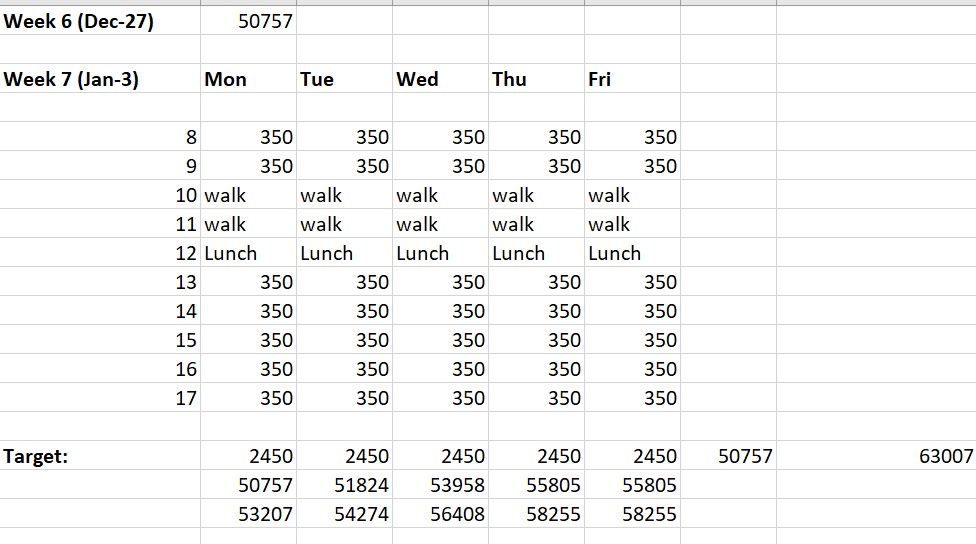
My planning session involves adding a week to my Workplan spreadsheet. I map out each day in the spreadsheet. It includes word targets and whether they have been met:
With the spreadsheet, I know at a glance whether I am on track or need corrective action. Looking at the target row, I can see I had 50757 words at the start of the week (January 3rd) and the target was 63007 by the end of the week. I complete the number of words written each hour and adjust accordingly. If I reach my daily target early, I usually stop and have a beer. If the words are flowing, I continue writing.
Checklist
Because I am of a certain age, my mental faculties have now decayed beyond the point where I can rely on memory. This is compounded by my not writing sequentially. Therefore, I keep a checklist of steps comprising all the planned scenes of the story, which always change over time, but heigh-ho, that’s the nature of a crumbling cookie.
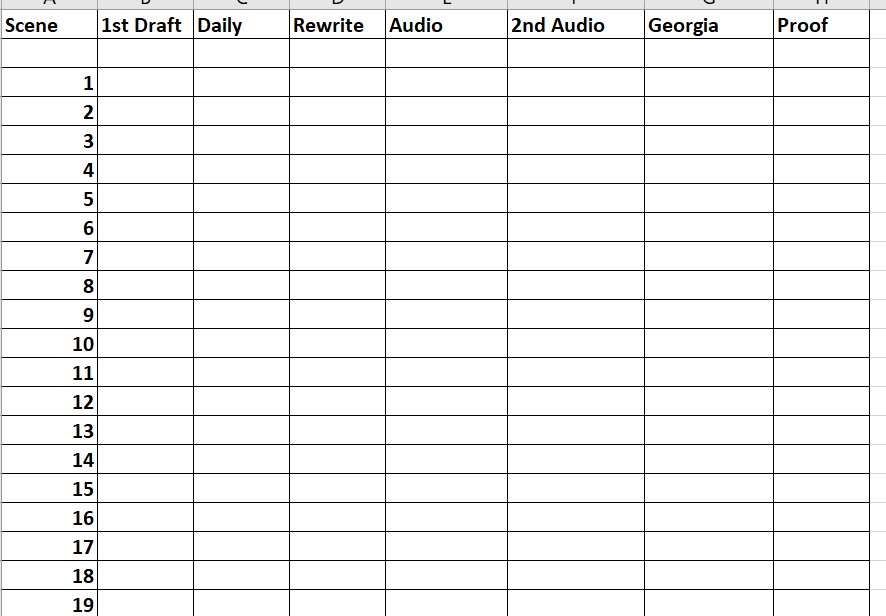
I print the following and sign off each scene as it is written by adding the date. I use a date because I will need to refer to it when doing a daily edit. Some of the columns happen after the first draft phase, such as the second audio edit.
Scene — The scene number.
1st Draft — The date the first draft was completed.
Daily — The date the daily edit was completed.
Rewrite — The date the rewrite was completed. This happens after I have finished the first draft read-through. Not many of the scenes should require a rewrite because I already performed a developmental edit — but things do change.
Audio — The date the first audio run-through is completed. I perform this step usually during the first draft writing phase, but it can vary.
2nd Audio — The date the second audio edit is completed. This stage is a complete run-through of the manuscript before I submit the file to my editor (Georgia).
Georgia — The date I complete the input from my editor. Not all input is implemented, of course. Sometimes an editor makes suggestions not knowing the subject matter as well as the writer. This is okay.
Proof — The date when the proofreading is complete. When this column is full, it is the point at which I send out Beta Reader and ARC copies.
When the first two columns are complete, I move the scene into my Manuscript file, keeping the scene number for backwards compatibility. Removing the scene numbers is the last step before I send the book to my editor for a line edit.
Daily Edit
I spend the first hour each morning doing a light copy edit of the scenes I wrote the day before. This is not a substantive copy edit, which comes later, but a brief run-through looking for glaringly obvious grammatical issues and typos.
Daily Writing
After copy editing, I choose which scenes to write from my spreadsheet. This can mean completing unfinished scenes or starting a new scene. Oftentimes, I will mull over a scene while I am not actually working, and I like to get them out sooner rather than later. For instance, I often take audio notes on my phone while walking the dogs, and I prefer writing them up while they are fresh in my noggin, so I start on those scenes as soon as I return from the walk
Writing each day is probably the easiest part of the process for me. When I choose a scene to write, I already know what it’s about and how I intend to move the story along with it, because of my scene spreadsheet. I also find myself planning the content of scenes in my head even as much as days in advance of writing them (using audio notes). Take the first scene I wrote in TAM, which was PO Jones with his face in a puddle of beer and blood. When I first started to conceptualise TAM, I knew there were three Italian cops on the scene, one more chauvinistic than the other, and that Rachel, as an outsider and a woman, was shunned by them. The rest just fell into place. At the first draft stage, the scene was ~1300 words long and took only a couple of hours to write.
As a bonus, the main theme of TAM was conceived while writing the scene: homophobia and sexual inequality in the armed forces. A great topic for 1970s Italy, which was complemented by male chauvinism. Women in any sort of professional capacity was unheard of. This was also true when I lived in Naples in the nineties and the noughties!
That was the first scene written, approximately midway through the story. So, where to next? A habit I picked up early in my writing career was to write the first and the last scenes first. It came about because readers of my early works complained that the stories just fizzled out, as though I became sick of writing them. I could relate because I got the same vibe from Neil Gaiman’s Stardust. For me, the solution was in writing the end very early in the process. I once again fly in the face of Stephen King’s pantsers when I say if I know where the story begins and ends, I can keep my focus. Mr King would say that stifles my creativity, but, as stated previously, my creative saliva flows during the creation of my corkboard.
In the initial draft, the first scene was Boccone (as my planned protagonist) being drummed out of the army. This changed later when I realised Rachel was the protagonist, not Boccone, and needed early air time. However, after the murder crime scene, I wrote Boccone’s discharge scene.
This is perhaps another area where the pantser versus plotter theory is not an accurate portrayal of the processes any writer follows. It is a misnomer that a plotter plots and sticks to it like a barnacle on an old boat. ThomasHardy used to write that way and, frankly, it shows. For me, and, I am sure many others, the early plot of any novel is not chiselled into the stones of a cathedral, but subject to change. Much of what I write never makes it into print. I have an outtake file, which is now larger than any of my novels.
Plotting does have its pitfalls. For instance, an easy habit to fall into is writing the easy scenes first. I’ve found that this can lead to getting a draft completed becoming a real chore and a possible cause of writer’s block. I have been guilty of trying to write all the difficult scenes first but this also led to the writing process becoming burdensome. Over time, I have found trying to balance easy and hard scenes is the best way to keep momentum. But even so, it is always the hardest scene that gets written last in my books because I keep deferring it until there is no other choice. If I could, I would avoid this trait because it does delay completing the first draft.
What constitutes a hard or an easy scene to write will, I suspect, depend on the writer. For instance, I wrote Rachel’s opening scene in TAM quite quickly, but when I submitted the scene to a group while on a writer’s retreat, the writers and the retreat holder all hated it, so it became difficult for me. It also became the opening scene of the book when I realised Rachel was the protagonist, thereby confirming Murphy’s Law.
Avoiding Blocks
Ah, the infamous writer’s block. I rarely suffer from writer’s block. This is because of two fundamentals in my process:
Plotting — Yes folks, here it is, plotting helps to avoid blocks. By definition, pantsers write sequentially. (If they don’t, then they must be plotting.) By plotting a story arc, if I become bogged down in a particular scene, I just switch. Backwards or forwards, makes no odds. I just select another scene from my spreadsheet and create a Google Doc where I start to write.
Multitasking — I always have more than one project ongoing. This means when I become blocked on a project because switching isn’t working (not a common occurrence) I move to a different project. A practical example would be an earlier Irish historical fantasy I wrote (AfterGairech, 2021). I got bogged down near the end of the first draft, and so began writing some scenes from TAM. I am also using my new book (Hammer) when I get bogged down in this blog.
Compiling the Manuscript FILE
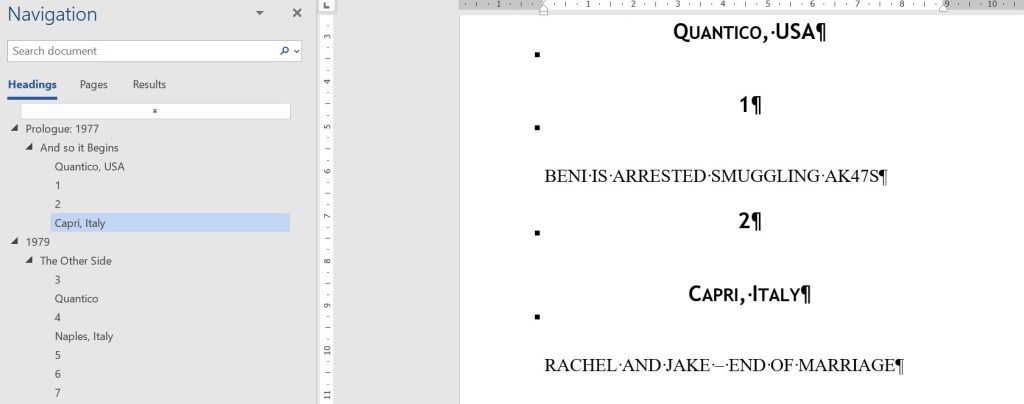
As illustrated in the following, the skeleton manuscript contains numbered scenes with some capitalised notes on the contents.
As I complete the first draft of each scene, I transfer the prose into my skeleton. In this way, I build the first draft of my story from the foundations up.
Research
Researching a topic involves — for me, at least — finding a balance. There will be a minimum amount of research required before I start to write but elements also pop up during the writing process. Take TAM, I wanted to have Rachel wearing a uniform while in the presence of the Admiral — not unlike John Travolta in The General’s Daughter — but I wasn’t sure if the NIS used to wear a uniform. Rather than stop writing, I added a string of question marks as a pro-memoria and carried on. Later, during the first draft editing phase, I came across the question marks and researched NIS uniforms during that part of the process. I discovered that the NIS don’t wear a uniform and a little rewrite was needed. This might seem like a waste, however, I find when I am in the zone, breaking it can have quite a detrimental effect and is best avoided.
Hibernating the First Draft
So, what happens when the first draft is ready, or the skeleton has had meat added to its bones?
Every creative writing course I’ve attended, as well as first draft writer’s retreats, have advised the same thing: put it away. I know that — second to writers killing their babies (or darlings, TheKing would say) — leaving a manuscript in a drawer for an extended period is the hardest part of writing (and especially finishing) a first draft.
Everyone also says print it: double line spaced 12pt. This will become the first draft read-through, which I will cover in the next part of the blog. I always put my manuscripts into a ring binder and label them. When I finally get my wall-to-wall shelving, they will be slotted into pride of place, my certificates of achievement.
Believe me, it’s worth the effort. After going cold turkey, hibernating a draft (usually for a minimum of three weeks) and coming back to it, the read-through feels like the book was written by someone else. This means I am much more objective and spot issues, both with the plot and the text.
I have found that the easiest way to forget about a manuscript is to work on another. This is not unlike being dumped romantically. Get a new love interest, and the old one is soon forgotten. This approach also helps create distance between me and the folder-bound stack of A4 sheets.
The historical mystery genre is one that I always enjoy, so I was very much looking forward to reading The Alcoholic Mercenary by Phil Hughes. The blurb of this novel was very convincing and I suspected that as soon as I started to read I would soon become swept up in the story. I am very rarely wrong, and once again I was right.
This novel is everything that a historical mystery should be.
Special Agent Welsh’s job is not made easy. It is the late 1970s and misogyny is seemingly unrelenting at work, and her husband cannot contain his jealousy when she is promoted. On top of this she wants to find out exactly what happened to her predecessor, but every time she broaches the subject a metaphorical door is slammed in her face. Rachel is a very strong and determined woman (you would have to be to carry on with the way she is treated), yet she also came across as very real. She silently seethes at her treatment and yet hides it behind a mask of indifference. She does not suffer fools gladly and she always has an inkling of when she is being played. I really enjoyed reading about Rachel. She is one of those characters that you can really get behind.
Nicola Di Cuma “Boccone” was a character that really helped to keep this story moving forward. Boccone’s brother, Beni, is in prison but the danger comes from his brother’s boss, a crime lord that thinks Berni has broken the code, and even a prison will not keep him safe from recompression. If his boss wants him dead he might as well dig a grave. Boccone understands the danger he is in and he wants to make sure his brother remains safe. And so, he enters a tangled web of lies, ambition, and murder and he becomes embroiled in the criminal gangs. I found Boccone endlessly fascinating, the choices he makes and the problems he faced made this book a truly gripping read.
I am really looking forward to reading more books by this very talented author.
It is self-evident that a novel needs a cast. It doesn’t matter if a book is a plot or character-driven story, there still needs to be those around whom the story revolves and evolves. Depth of character is paramount in the modern reader’s perspective. Having read hundreds of one-star reviews of books, a common theme has been characters who lack depth.
So, how do I add depth of character? Before getting into how I created the characters in TAM, I think I should outline what I feel makes a good character.
Good Character Profile
Many will tell you that you need to know what you are writing about, which is, of course, utter nonsense. How can writers of sci-fi or fantasy really know their subject? They can’t. They invent it. Still, others believe in the method acting approach: living as your character. I read “be your character” in one of the many articles I devour. It seems a little blasé and unrealistic. How can I be my character when I write pre-Christian Irish historical fantasy and Mafia-based murder mysteries? My characters spend their time chopping off heads, stealing and raping, drinking and debauching or shooting people who don’t pay their protection money. If I took a method acting approach to being my character — as the article author seems to be suggesting — I would not last too long this side of high walls with razor wire on top. But what did the author really mean? I am sure it wasn’t that I had to put on some plaid trouse, get out my longsword, and head into the hills of Ireland looking for a settlement to rob.
So, let me take a logical look at the theory you need to have experienced something to be able to write about it. No one has ever flown a dragon or a broomstick in a Quidditch match. I am also sure that most crime fiction writers have never committed a crime, at least not a crime that would make for an engaging novel. Personally, I think the key is different. I believe a good novelist requires a vivid imagination and extensive research. I am sure that Thomas Harris had no first-hand experience of sociopathic killers when he wrote the Hannibal books, but the depth of research in the character he created is patent. So much so, that Anthony Hopkins portrayed Hannibal so well, he got an Oscar after only sixteen minutes of screen time.
So, what does that mean in terms of character? In the end, it comes down to what, I think, is a simple list. Give characters realism; make them relatable; make them individual; give them conflict.
Realism
Characters must be realistic. Readers need to invest in them and believe in them. So how do we writers achieve that? There are several ways to make characters realistic. Not least would be giving them fallibility. Let them make mistakes. There is nothing more real than falling over occasionally. No one goes through life error-free. Take Gandalf, he went off and left Frodo alone with the ring, when he should have run for the hills, Frodo in tow, as soon as he suspected what it was. Then he led them into the mines of Moria, knowing there was something dreadful in them, but being too fallible to go against the wishes of the fellowship.
Make them complex. There is nothing less real than a one-dimensional character. There need to be layers that the reader can discover through the journey the character is making: their arc. Even the villains need the layers. Take Sergeant Troy in Far From the Madding Crowd; pure villain, but multi-layered, evidenced by his attempted suicide after discovering the death of his one true love.
Relatable
The reader needs to feel a connection to the characters. Even the bad ones need to garner a little sympathy or some understanding. To immerse themselves in the stories, our readers need to be able to say, “yes, that is an understandable reaction”, even when it is not something they would condone. This gives characters their humanity: the old Alexander Pope-ism about erring being a trait of humanity. Angus Thermopyle from Donaldson’s Gap series is a good example. The way he treats Morn Hyland is despicable, evil incarnate, for want of a better cliché. But the reader is given the backstory to Thermopyle’s evil, which, although it doesn’t excuse his actions, does go some way towards explaining them.
Individuality
Each character needs to be their own person. They need to have their quirks and their habits: a certain nuance in speech; a particular tic; a quaint turn of phrase: something that is unique to them. Henry Treece’s Heracles in Jason is a good example. Treece made Heracles a homosexual eunuch, which was a particularly unique take on the character, giving the story of Jason and the Argonauts another dimension. A slightly less well-known character, at least for now, is Inspector Laconto from the Time to Say Goodnight series: Laconto smokes Gauloises at murder scenes because he can’t stand the smell of death, a unique trait for a copper.
Conflict
Characters need to have troubles to overcome to generate interest in them. If they move from scene to scene without defeating any demons, then the story will be flat. It does not matter what those demons are, the inner demons of a character of literary fiction — such as Boccone’s alcoholism — or the fire breathing type from epic fantasy, conflict keeps the interest of the reader and, therefore, the pages turning.
So, How do I Create Characters?
As I describe in Corkboard I first add a list of characters to my corkboard. At this stage, they are nothing more than a vague idea of a name and, maybe, a little backstory. Take the Alcoholic Mercenary, originally, his name was going to be Brando, but as the plot developed I found his brother’s name was Beni (short for Benito) and the names were too similar, so Nicolo was born.
Bio
When I have a list of characters, I create a bio for each of them. For bit-part characters, their bio is less detailed, but I do create one. The following are bios for TAM’s main protagonist, Rachel Welch and the main antagonist, Nicolo Di Cuma.
Rachel
She was born in Poughkeepsie in the mid-fifties. She had a turbulent time in high school, which impacts her day-to-day life quite significantly. She is driven because she will never allow herself to be forced back into her shell. She feels her husband let her down. She is a good-looking woman. When writing Rachel’s scenes, I envisaged Angelina Jolie in The Bone Collector, who was driven but unsure of herself.
At the beginning of the story, Rachel raises a barrier and comes across as hard and unforgiving. As the story proceeds the reader begins to realise it is a facade.
I do find that my characters change while I am writing them. I don’t mean the change that is required as part of a story, but my ideas about them, their character, backstory, and so on.
Boccone
Boccone was born in Pozzuoli in the late forties. In 1979, when the story is set, he is thirty (ten years older than his brother, Beni). His father was murdered in a clan war in the early sixties. When his father was murdered, his mother became an alcoholic, unable to cope with the struggle of bringing up two young sons. Driven by drunkenness, she became violent towards Boccone, eventually driving him to leave home and join the army.
When writing Boccone’s scenes, I envisaged Keifer Sutherland in 24 Season 8, when he became psychopathic after his love interest was murdered. Boccone has dark hair and complexion but is otherwise Jack Bauer in my imagination.
When I have finished my corkboard — not forgetting that I am already writing — I create a Scene-Plan spreadsheet.
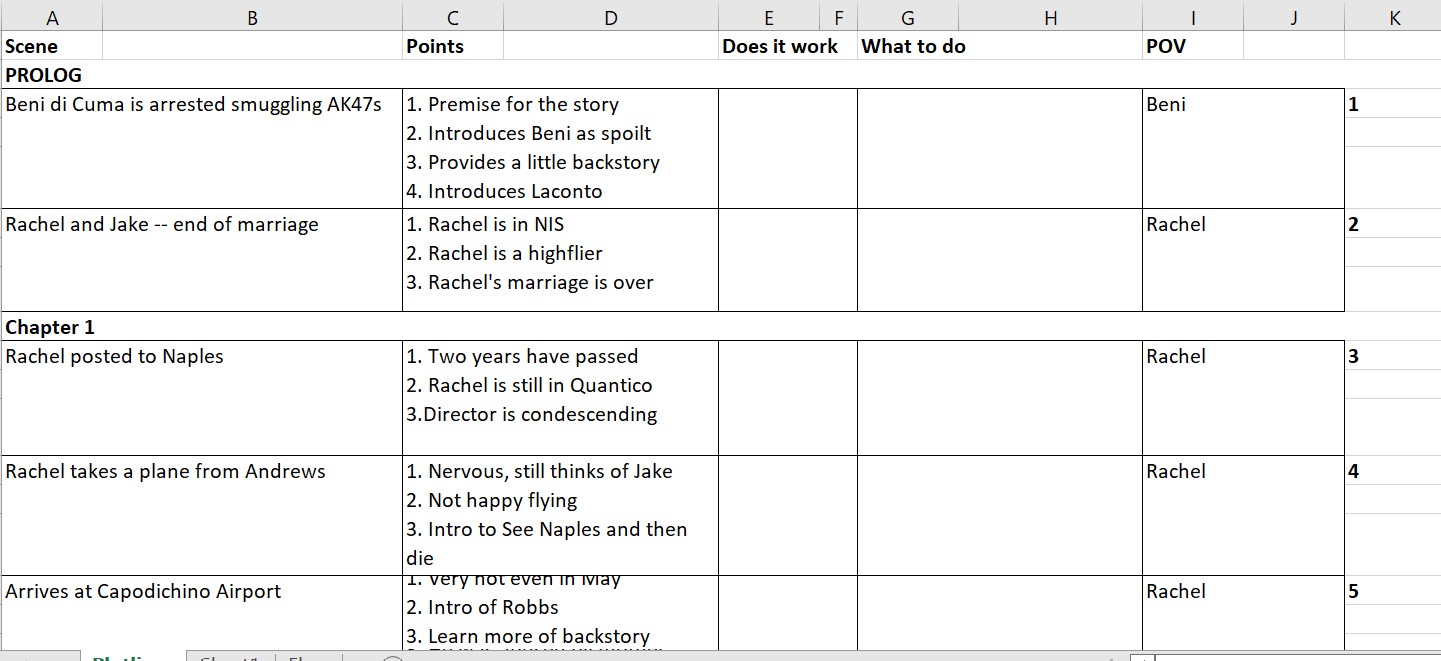
The document comprises the post-it notes that survived my first cull transcribed into a spreadsheet with a little more detail. I use the spreadsheet throughout the book’s pre-publication lifecycle. For instance, I rely on it during the editing phase, which I will document in a later blog.
I don’t use the Does it work and What to do columns until the full draft is complete and I am editing the book.
Scene — A high-level pro-memoria to what the scene involves. This doesn’t need any detail, just enough to keep me apprised of the scene’s purpose.
Points — Main plot points of the scene. Some schools maintain a scene requires a minimum of three. I don’t agree. As long as the scene moves the story along, I don’t think it matters. In fact, I would go so far as stating a chapter with only one scene and only one point, can, if used sparingly, have a great dramatic effect.
POV — I find it useful to have a reminder of the point of view. Modern story theory maintains that in a third-person limited novel, each scene should only contain one POV. Obviously, with first-person or third-person omniscient, the theory is not relevant.
While I am creating the spreadsheet if I notice any holes, incongruencies, or surviving redundancy from the first cull, I cull again.
When I am happy with the spreadsheet, I create the Document Skeleton.
After the spreadsheet is completed and once again culled, I create a skeleton document. This document will eventually become the manuscript.
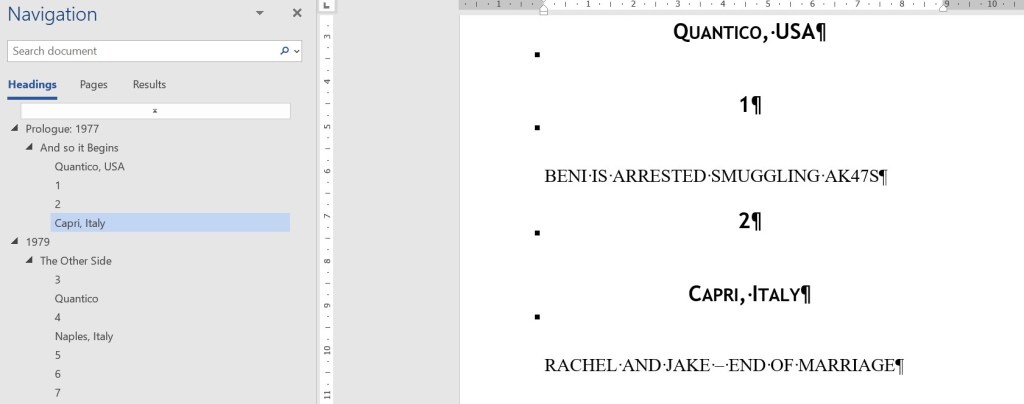
The numbers represent the scene number in the spreadsheet and are removed prior to publication. Although the graphic shows the document with chapter divisions and titles, they do not come in until much later in the writing process, which I will document in the next blog.
Although not a sequential process (I begin writing before the skeleton is complete), the next stage of my journey is That Writing Thing.
Before I became a novelist, I spent more than thirty years as a technical writer and editor, the last ten of which I was the Documentation Manager in a Multinational Software Company. During those thirty plus years — and especially the last ten — I designed libraries of supporting documentation for enterprise-level software applications. There was no room in that environment for meandering. But the world of creative writing is different. Or is it? Fundamentally, I would argue that it’s not. Whether you are writing a novel or a programming guide for a platform API, the key is accurate communication. Getting the message across. In the world of technical documentation failing to get the message across can be devastating.
While working for a well known Global Software company, a colleague badly worded an instruction for network administrators running a financial platform. The misinformation caused a global crash of a credit card company’s network, and ultimately cost the mother company millions in reparations. Not getting the message across in a novel would be far less devastating, but is still important. Why write if not to convey something accurately?
A key aspect of getting a message across is good structure and a key element of good structure is plotting. I like to use the analogy of driving on a country road at night with the headlights on. Driving with the headlights on means everything can be seen and crashing is less likely. I read a similar analogy in favour of pantsing, where driving without a map or GPS creates a much better adventure, but, of course, it also increases the chance of getting lost, or ending up in the backend of nowhere.
To Pants or not to Pants
Pantsers would say they prefer writing by the seat of their pants because it gives them more creative freedom than plotting allows. If a pantser has no idea where the story is going, they claim, then there is nothing holding them back. They can go where their creativity takes them. As far as it goes, this theory might be valid but for me, it has some serious flaws. Looking at Stephen King’s method of writing, that is, responding to “what if situations”, and following the pantsing logic, characters will end up breaking their own character traits, the plot will meander without a clear direction, and there is a very high risk of the author getting bogged down in writer’s block because they can’t work out where to go next: driving round and round spaghetti junction looking for the correct exit. Stephen King admits as much in On Writing, where he was blocked from writing The Stand (for several months) because he didn’t know how to go on.
As far as I am concerned, there is no such thing as pantsing. What I mean is, if someone starts to write in response to, for instance, what if a town is full of secret vampires, and then writes a series of scenes, the first draft becomesthe plan. This is simply because all the issues an initial plan would have avoided, need to be fixed as part of the first rewrite, which in turn leads to at least another rewrite. Besides, what if a town is full of secret vampires, is already a plot, if at a very high level.
From What If to Plot
Using the example of The Alcoholic Mercenary (TAM) the “what if” situation came about because of an earlier novel — The Reticent Detective (2019) — where two of the main characters met in the backstory, that is, when investigating the murder of an American sailor. So, I developed that backstory into a novel: what if an American sailor was gunned down in Baia. I based the character of the sailor on a Petty Officer I knew who was directly involved with the Mafia, selling smoke rations to his local clan in Baia. He was not a nice person, so it was easy to imagine him with what was left of his face resting in a puddle of beer and blood. I had the premise and two of the main characters, all I needed was to pull together the elements of a story in a series of events that rise to a climax and then return to the original context.
Because I have adopted a technical approach to novel writing, I use a hybrid method, which is similar to the so-called Agile Development Process. Agile requires planning but only loosely. It is not the same as the old-fashioned waterfall development process, where everything is planned finitely before development begins. In agile development, a goal is set and then a series of Epics (requirements) are designed. In response to the epics, stories are developed, basically breaking each epic into bite-size chunks. Development can begin before planning is finished.
What crosses my mind after any “what if” moment — apart from story scene ideas — is what comprises a story and how each of my scenes might fit. In TAM, the first scene to mind was that of the sailor, shot dead outside a bar. It was not the beginning, so how did the story get to that point? This is where Stephen King would start to write. And this is where my bone of contention really lies, because this too is the point at which I start to write, only I write high-level scene reminders rather than a first draft. That is still a creative process. Basically, I write the first draft (the plan) in a few hours, which is far easier to correct and — for me — saves time in the overall writing process. Pantsers also write a plan, in much more detail, and over a much longer period, they just call it the first draft.





 PerchedCrowPress